
United Airline Status Levels & Star Alliance Benefits

PointsCrowd is a community-supported platform. When you apply for a credit card, make an order, or otherwise interact with the advertisers through the links on this page we may earn an affiliate commission. This helps us maintain and develop the platform further at no cost to you.
United Airlines MileagePlus has a great elite status setup. It gives you perks when you fly United, but also unlocks cool stuff across the whole Star Alliance network. Think priority boarding, free checked bags, and even upgrades on some flights. Having United status can really change your travel game.
Figuring out how it all works and what you need to do to get status can be tricky. They use PQF and PQP to measure your progress, and there are different ways to hit those goals. You can also speed things up with special deals, status matches, credit card spending, and other tricks.
This guide will explain each United Premier level. You’ll learn what it takes to earn them, the best ways to get there (including the newest deals), and what you get at each level. We’ll also look at how United status matches up with Star Alliance, so you know what you get around the world, even if you’re not flying United. Whether you want to get Premier Silver or go all the way to Premier 1K, this guide will give you the info you need to understand United status and make it work for you.
Here is an article-style overview of the elite status levels of United Airlines’ MileagePlus program — what the levels are, how to earn them (including via promotions or status match), their benefits (on United and via Star Alliance), and how they compare to “pure” Star Alliance status. I refer to existing public guides (including ones like the one you mentioned).
What are United’s Status Levels
United currently offers four published “Premier” elite-status tiers under MileagePlus:
- Premier Silver — the entry-level elite tier.
- Premier Gold — the second tier.
- Premier Platinum — a higher-tier for frequent flyers.
- Premier 1K — the top published tier for most “regular but heavy” flyers.
There is also a by-invitation–only “secret / ultra-elite” tier, Global Services, reserved for United’s highest-spending customers. Exact qualification criteria are unpublished.
In addition, United has a “lifetime loyalty” path via another program (often referred to as the “Million Miler” program) that — after you’ve flown a certain total number of miles over many years — can grant lifetime status.
How to Qualify: PQF, PQP (and What They Mean)
United uses a combination of two metrics (or, optionally, a higher threshold of just one) to qualify for Premier tiers:
Key definitions
- PQF — Premier Qualifying Flights: counted per flight segment (takeoff + landing), for flights operated by United (or United Express). Basic-economy tickets (and some other exceptions) may not earn PQFs.
- PQP — Premier Qualifying Points: a “spend-based” metric. For United-issued tickets, you earn 1 PQP per dollar spent on base fare and carrier-imposed surcharges (taxes & fees typically excluded).
You can qualify via PQF + PQP (i.e., a mix of flights and spending) or via PQP only — though the “PQP-only” thresholds are higher.
Also — note a key 2025 update: United raised all PQF/PQP thresholds by about 20–25% compared to previous years.
Here are the 2025/2026 requirements:
| Tier | PQF + PQP path | PQP-only path | Minimum paid segments |
|---|---|---|---|
| Premier Silver | 15 PQF + 5,000 PQP | 6,000 PQP | at least 4 paid United/United Express segments |
| Premier Gold | 30 PQF + 10,000 PQP | 12,000 PQP | same minimum segments requirement |
| Premier Platinum | 45 PQF + 15,000 PQP | 18,000 PQP | same |
| Premier 1K | 60 PQF + 22,000 PQP | 28,000 PQP | same |
Note: the requirement to fly at least 4 paid segments on United/United Express in a calendar year applies to all tiers.
Thus, status is achieved not by miles flown (distance), but by the number of flights + money spent. This reflects a shift many airlines — including United — have adopted.
You can also earn PQPs outside of simply buying flights — for example, via certain United cobranded credit cards, or by paying for seat upgrades / Economy Plus / preferred seats.
Shortcut Paths
Because of the 2025 increase in qualification thresholds, many travelers now seek ways to “fast-track” status. Some of the common strategies:
- Use United cobranded credit cards (or other eligible spend) to earn PQPs on non-flight spending (or everyday purchases). This helps reduce the number of flights needed.
- Keep an eye on occasional “status-match / challenge” offers: under certain campaigns airlines (even non-United) may allow matching from another frequent-flyer program to a United Premier tier — effectively giving you a head start toward status.
- If you don’t fly often but do a lot of spending via United (or co-branded partners), the PQP-only path can be the most efficient route to status.
What You Get — Benefits by Tier (United + Star Alliance)
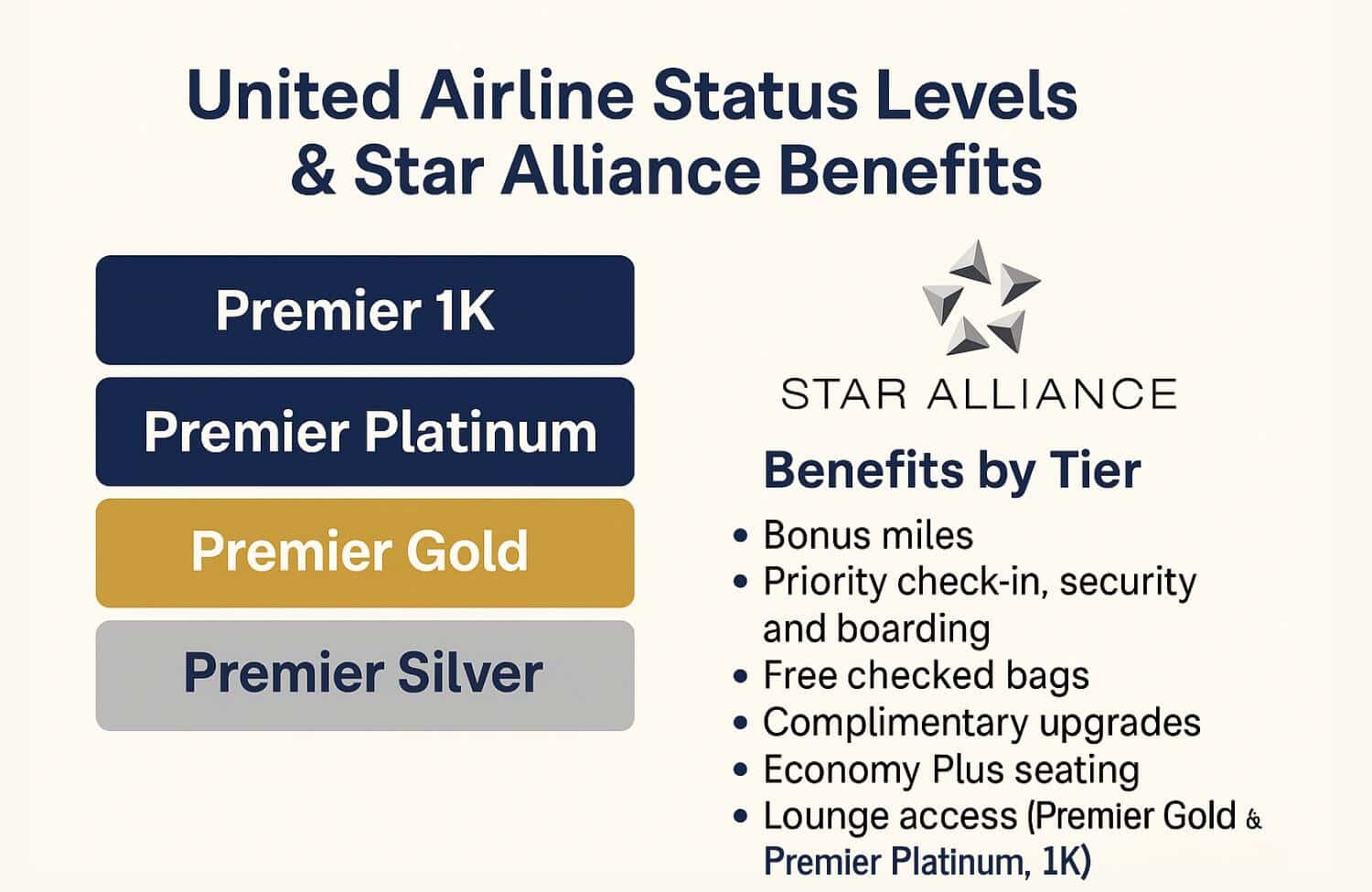
The value of United status lies in both on-United perks and global Alliance perks when flying with Star Alliance partners.
As you climb levels, you get increasing perks — better baggage allowance, upgrade privileges, bonus miles, priority boarding / check-in / baggage, etc. Here are some of the highlights by tier.
Premier Silver
- Bonus miles on United flights (vs base members).
- Priority check-in, security/boarding (often “Group 2”).
- One free checked bag (on eligible fares).
- Complimentary access to “Economy Plus” seating (though seat assignment may only open at check-in).
- Space-available upgrades on domestic/short-haul routes (Y/B full-fare) when available.
Premier Gold
- Two free checked bags.
- Higher chance of complimentary upgrades — better upgrade priority.
- Ability to select Economy Plus at booking (vs check-in for Silver).
- For many carriers/routes: access to premium/priority services, lounge access on international itineraries, better award-ticket handling.
Premier Platinum
- Three free checked bags.
- Better upgrade priority than Gold; higher chances of moving to first class / premium economy, on both domestic and some international flights.
- Access to a pool of upgrade “currency” — PlusPoints (40 PlusPoints granted upon reaching Platinum).
- Access to most Star Alliance Gold benefits when flying with partner airlines (see below).
Premier 1K
- Same baggage allowance (3 bags) but top upgrade priority among publicly published tiers.
- Larger PlusPoints allocation: 280 PlusPoints on qualification.
- On domestic flights, ability to get upgrades earlier, including possibly at booking (depending on fare class) on many flights.
- Extra benefits: priority boarding (“pre-boarding”), priority baggage handling, better award-ticket flexibility (cancel/changes), and more personalized support (dedicated phone line for 1K).
Global Services (invitation only)
Benefits are not fully public, but historically include personalized service, top-tier upgrade priority, elite treatment (private check-in / security at some airports), and other “VIP-style” perks.
Plus — United elite status affects how many miles you earn for flights: higher tiers get bonus miles per dollar spent on base fare. For example, Premier Silver, Gold, Platinum and 1K give progressively larger mileage bonuses.
Also: for Platinum and 1K, PlusPoints can be redeemed to upgrade flights — from economy → premium, or premium → business/first (on eligible flights) when space is available.
| Benefit | Premier Silver | Premier Gold | Premier Platinum | Premier 1K |
|---|---|---|---|---|
| Mileage bonus | 40% | 60% | 80% | 120% |
| Free checked bags | 1 bag | 2 bags | 3 bags | 3 bags |
| Priority check-in & boarding | Group 2 | Group 1 | Premier Access | Premier Access + pre-boarding |
| Security priority | Yes | Yes | Yes | Yes |
| Economy Plus seating | At check-in | At booking | At booking | At booking |
| Complimentary Premier Upgrades (domestic) | Low priority | Medium priority | High priority | Highest priority |
| PlusPoints | — | — | 40 points | 280 points |
| Award ticket changes/cancel | Standard | More flexible | Very flexible | Most flexible / waived fees in many cases |
| Standby priority | Yes | Yes | Yes | Yes (highest) |
| Star Alliance status | Star Alliance Silver | Star Alliance Gold | Star Alliance Gold | Star Alliance Gold |
| Star Alliance lounge access | No | Yes (international itineraries) | Yes | Yes |
| Extra baggage on Star Alliance carriers | No | Yes | Yes | Yes |
| Priority baggage handling | No | Yes | Yes | Yes |
| Dedicated phone support | Standard | Standard | Priority line | 1K line (highest priority) |
Global / Star Alliance Benefits: Why It Matters Internationally
Because United is a founding member of Star Alliance, achieving a certain Premier level also confers you a matching “Alliance-level” status — useful when flying with nearly any other member airline in the Alliance worldwide.
- Premier Silver → Star Alliance Silver
- Premier Gold (and higher: Platinum, 1K) → Star Alliance Gold
What does that mean when flying e.g. with Lufthansa, Singapore Airlines, Turkish Airlines or any other Star Alliance member? Typical alliance-level perks include:
- Priority airport services: check-in, baggage handling, standby wait-list, priority boarding (depending on airline)
- Additional baggage allowance (often one extra checked bag or extra kg/piece under baggage rules) under Star Alliance Gold.
- Access to business / lounge facilities on international flights (when departing on a same-day itinerary with a Star Alliance carrier and you have a boarding pass for that carrier) — a big perk for long-haul travel.
- Priority on award waitlists and standby lists. Star Alliance Silver already offers standby / waitlist priority (though few other perks).
Thus, even if you rarely fly on United itself, having Premier Gold/Platinum/1K status can dramatically improve your experience when traveling internationally with Star Alliance carriers.
Alternative Qualification Paths
Because status qualification via PQF + PQP can be expensive or flight-heavy, many frequent flyers use alternative tactics:
Credit card spend
United cobranded credit cards (and other qualifying spend) remain a popular way to earn PQPs without flying. This helps particularly when you don’t fly often but do spend on other services (car rentals, hotels, seat upgrades, etc.).
Status-match / Challenge campaigns
Occasionally, United (or partners) run status-match offers — allowing you to match from another airline’s frequent-flyer status into a United Premier tier (typically temporarily, or for a “challenge period”). If you meet United’s requirements during that period, you keep the matched status for the remainder of the year (plus the normal validity for the following year).
Mix of flights + spend
For many moderate-to-frequent flyers, combining a handful of flights with strategic spending (on seats, upgrades, co-branded cards etc.) is the “sweet spot” to reach Gold or Platinum without needing to fly dozens of segments.
Because United raised the qualification thresholds in 2025 for the 2026 status year (approx. +25%), these alternative paths have become more attractive again.
Who Should Target What Level?
- If you just fly with United now and then (like one or two trips a year) and don’t usually go overseas, it might not be worth trying to get even Silver status. It takes a lot of time or money.
- Now, if you travel to other countries a lot (mainly with Star Alliance airlines) or fly fairly often (like for work or long trips), then going for Premier Gold or Platinum is a good idea. You’ll get good use out of things like lounge access, free bags, chances for upgrades, and benefits with all the Star Alliance airlines.
- If you’re a frequent flyer (taking lots of flights each year or spending a lot on business or first-class tickets), Premier 1K is still the best level to aim for. It’s worth the cost, especially if you’re planning to use upgrades or PlusPoints and want priority service.
- If you only fly once in a while but still want some status, you can get it by just earning PQP (especially by using a credit card) or by temporarily matching your status from another airline. This is a simpler way to get at least some Star Alliance perks.
Just so you know, United made it harder to reach each status level for 2025/2026. So, it now costs more in terms of flights or spending to get there. That means it’s important to check the numbers (miles vs. spending vs. what it’s worth) before you try to get status.


