
Atmos Gold vs Platinum Elite Status Atmos Rewards

PointsCrowd is a community-supported platform. When you apply for a credit card, make an order, or otherwise interact with the advertisers through the links on this page we may earn an affiliate commission. This helps us maintain and develop the platform further at no cost to you.
Travelers who frequently fly with Alaska and Hawaiian and the oneworld global alliance may find it useful to understand the difference between the two flagship elite tiers, Atmos Gold and Atmos Platinum.
Let’s break down how Atmos Gold and Platinum work, who should aim for each tier, how best to qualify for the program, and how to avoid common pitfalls so you can turn your loyalty into meaningful value, not just a shiny status badge.
Gold is the middle tier (oneworld Sapphire), and Platinum is the highest tier (oneworld Emerald). They exist to reward the most loyal passengers — those who travel frequently, spend more, or have premium cards — with a more comfortable, convenient, and rewarding travel experience. These benefits are designed to save you money, get you better seats, and let you skip the lines — if you know how to use them.
Quick Comparison: Atmos Gold vs Platinum at a Glance
Let’s start with a side-by-side comparison table so you can see the core differences in one scan. Below, we’ll unpack the details, exceptions, and strategies that matter most.
| Feature/Benefit | Atmos Gold (oneworld Sapphire) | Atmos Platinum (oneworld Emerald) |
|---|---|---|
| Status Points Needed (2026) | 40,000 | 80,000 |
| Status Validity | Rest of year earned + next calendar year | Rest of year earned + next calendar year |
| Lifetime Status Threshold | 1,000,000 flown miles (Alaska/Hawaiian) | 2,000,000 flown miles (Alaska/Hawaiian) |
| Mileage Bonus on Flights | 50% | 100% |
| Free Checked Bags (per trip) | 2 (member + companions) | 3 (member + companions) |
| Premium Class Upgrades | Most fares (Y, B, H, K, M, L, V, S, N) | All but Saver (X) fares |
| First Class Upgrades | Y, B, H, K fares | Adds M fares, higher priority |
| Lounge Access (home network) | Alaska Lounges (int’l itinerary only) | Alaska Lounges (int’l itinerary only) |
| oneworld Lounge Access | Business-class lounges (int’l only) | First-class lounges (int’l only) |
| Main Cabin Drink/Snack | Yes (premium drink/chocolate) | Yes (plus complimentary meal in Main) |
| Same-day Change Fee Waiver | Yes (Main/First fares only) | Yes (Main/First fares only) |
| Standby/Upgrade Waitlist Priority | Above Silver | Top priority (except Titanium) |
| American Airlines Perks | Main Cabin Extra seat access, upgrades | Same, plus higher priority |
Key Warnings (Read Before You Chase Status)
Before pursuing elite status, it is important to understand the key points. Read this to proceed.
Any Atmos Rewards elite status is valid only until December 31 of the following year. For example, if you receive Gold status in July 2026, it will expire on December 31, 2027.
Saver (X) fares do not earn any status points or upgrades. These basic fares (equivalent to basic economy) may earn a small number of miles, but do not earn elite points or upgrades.
Booking travel online can be tricky. If you use a third-party agent (Expedia, etc.), make sure the ticket has an Alaska code. Partner codes for sharing and booking outside the official channel do not earn status or upgrades — always check this before booking.
To make this even clearer, here’s a quick “cheat sheet” table of the most common fare/booking types and whether they count toward Atmos status or upgrades:
| Fare/Booking Type | Status Points Earned? | Upgrade Eligible? |
|---|---|---|
| Alaska/Hawaii Saver (X) fares | No | No |
| Award flights booked via a partner program (AA, etc.) | No | N/A |
| Paid Alaska/Hawaii fares (Y, B, H, K, M, L, V, S, N) | Yes | Yes (if seats available) |
| oneworld partner flights (credit to Atmos) | Yes (if fare eligible) | Yes (per partner rules) |
A paid Hawaii Airlines flight should earn points if credited to Atmos, but the same flight booked through an airline partner site might not.
How Do You Qualify?
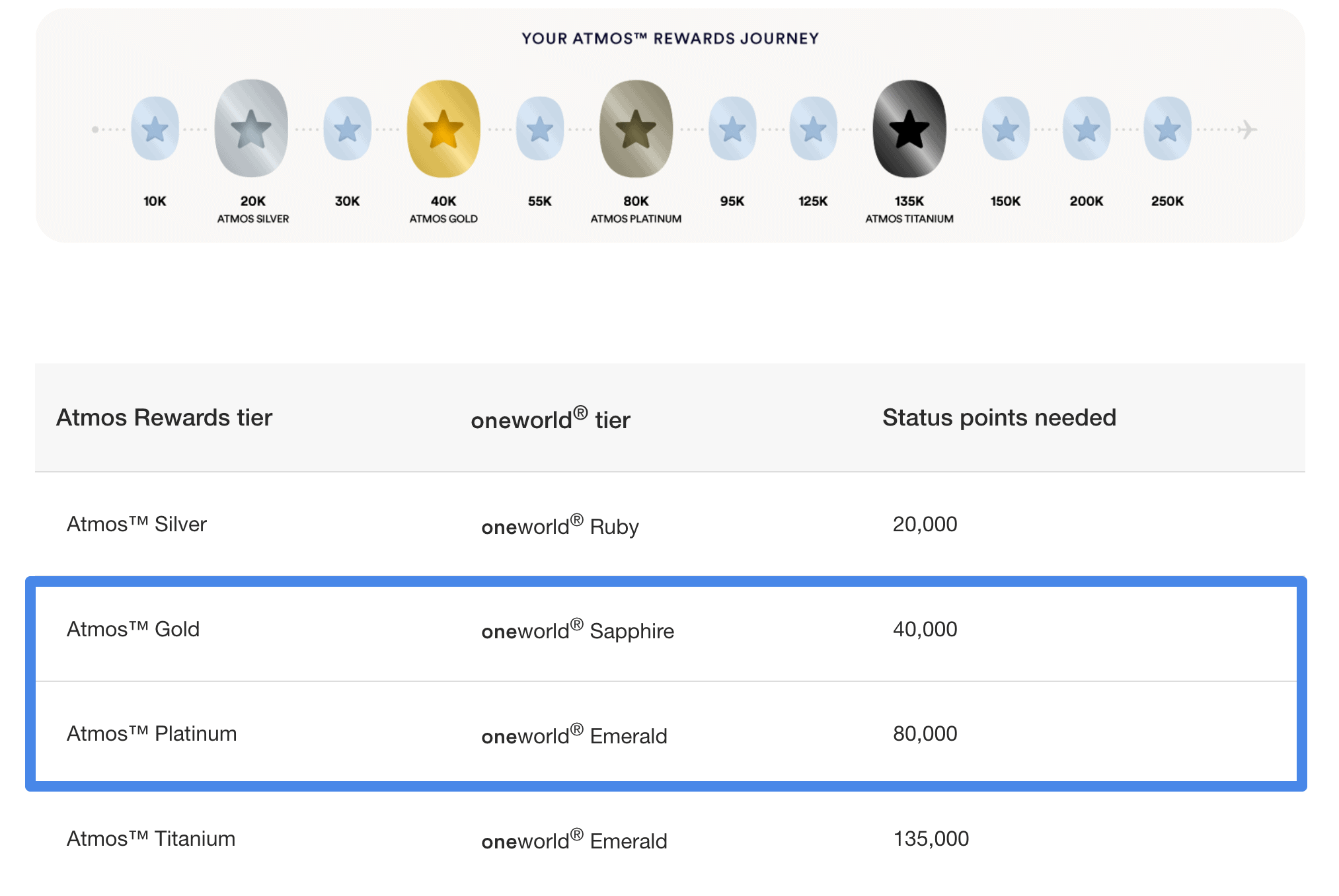
To earn Atmos Gold or Platinum, you need to hit a status points threshold within a single calendar year. These points can be earned through flying, credit card spend, or eligible partner activity — but not all flights or fares count.
Qualification Table:
| Status | Annual Points Needed | Lifetime Miles Needed | Validity Period |
|---|---|---|---|
| Gold | 40,000 | 1,000,000 | Rest of year + next calendar |
| Platinum | 80,000 (2026) | 2,000,000 | Rest of year + next calendar |
- Requalification: You must re-earn the threshold every calendar year to keep your tier. There’s no “soft landing” – if you fail to hit Platinum again, you drop back to Silver or below at year’s end.
- Lifetime Status: If you’re a multi-million miler, Alaska grants lifetime Gold at 1,000,000 flown miles and lifetime Platinum at 2,000,000 (across Alaska/Hawaiian only).
All Ways to Earn Atmos Gold and Platinum Status
Atmos Rewards gives you several ways to rack up status points, but the best method for you depends on your travel patterns and spending habits.
1. Flying Alaska/Hawaiian and Partners
- Paid flights: Earn status points on all paid fares except Saver (X). Points are credited based on your chosen earning method for the year:
- Distance: 1 point per mile flown.
- Dollars: 5 points per dollar spent (base fare + carrier fees).
- Segments: 500 points per flight segment flown.
- Partner flights: oneworld and select partners qualify if you credit them to Atmos Rewards and the fare class is eligible. For example, a paid British Airways or Finnair ticket can earn Atmos points when credited, but only if Alaska participates in that code share. (Alaska’s website and call center can confirm before you buy.)

2. Credit Card Spend
The Atmos Summit Visa earns 1 status point per $2 spent (no cap) and a 10,000-point anniversary bonus each year. This can be a game-changer for those who spend heavily on cards but fly less. If you’re close to a threshold, targeted card spend can push you over the line without extra flights.
Starting January 1, 2026, eligible purchases on the Atmos Rewards Ascent Visa Signature, Atmos Rewards Visa Business card, and Hawaiian Airlines World Elite Mastercard will earn 1 status point per $3 spent, with no cap on how many status points you can earn through spending.
3. Award Flights (But Only If Booked Right)
- Only award flights booked via the Atmos Rewards portal (or Alaska/Hawaii’s site) and credited to your Atmos account earn status points (1 point per mile flown).
- If you book the same award flight through a partner program (e.g. AAdvantage, HawaiianMiles) and then try to claim credit with Atmos, you will get nothing. Atmos’s rule is clear: “You must have booked your award ticket through the Atmos Rewards program, and not through a partner frequent flyer program”.
4. Partner and Promo Activity
Some partner promotions or targeted bonus promotions can add to your status point total, but these are more the exception than the rule. Don’t count on them to hit Gold/Platinum—treat them as icing on the cake when they appear.
5. Status Match Challenge
Both Gold and Platinum status can be obtained through a challenge involving matching statuses with other airlines. A 90-day trial period is provided to enjoy the privileges, with the possibility of extending elite status by meeting reduced qualification requirements (for Atmos Gold: 10,000 base points earned on Alaska and Hawaiian flights, and for Atmos Platinum: 20,000 base points earned). You can only take advantage of this program once in your lifetime. All details in the article – Alaska Airlines Status Match Challenge.
You must select your earning method (distance, dollars, or segments) at the start of each year, and you’re locked in until the next January. Choose wisely based on your expected travel.
Atmos Gold Benefits
Atmos Gold opens the door to a robust set of perks that can transform the way you travel—if you use them strategically.
- 50% Mileage Bonus: Every paid Alaska or Hawaiian flight (except Saver fares) earns you 1.5× the base miles, which adds up quickly for frequent flyers.
- Two Free Checked Bags: For you and all companions on the same reservation—worth $30+ each way per bag on most routes. (That’s up to $1,200 saved per year if you meet the Gold threshold.)
- Priority Boarding (Group A): Skip the crowds and secure overhead bin space first.
- Premium Class Upgrades: Complimentary upgrades to Premium Class (extra legroom) at booking for most fare types (Main Cabin fares Y/K/M/L typically qualify).
- First Class Upgrades: Eligible for free First Class upgrades on select fare classes (Y, B, H, K) within North America, plus one companion if on the same reservation. (If you don’t see your upgrade clear by departure, it means the flight is full or Minnie Mouse needs a front-row seat.)
- Oneworld Sapphire Status: As an Alaska Gold (Sapphire), you get access to oneworld business-class lounges when flying internationally on any oneworld carrier (e.g. Cathay Lounge in HKG, BA Galleries in LHR). Note you cannot enter first-class lounges without Emerald status.
- Complimentary Premium Drink or Chocolate: Main Cabin and Premium Class passengers on flights over 350 miles get a free premium beverage or chocolate. It’s a small perk, but the little things add up (think $5+ latte after a long connection).
The real value of Gold lies in the combination of mileage bonuses, baggage savings, and consistent upgrade opportunities – especially for those who fly regionally or with family.
Atmos Platinum Benefits
Atmos Platinum builds on all Gold perks and raises the stakes.
- 100% Mileage Bonus: Double miles on all eligible flights. If you fly often or on pricey itineraries, this can be a huge accelerator for free travel.
- Three Free Checked Bags: For you and all companions on one reservation. One more bag rack? Check.
- Upgrades on More Fare Classes: Platinum expands complimentary First Class upgrade eligibility to include M fares (mid-level discounted Main cabin). You also get much higher priority on the upgrade list. (Platinum upgrades often clear as early as 5 days out on transcons, vs 2 days for Gold.)
- First-Class Lounge Access (oneworld Emerald): When flying internationally, you can now access first-class lounges on oneworld partners – think Qantas First lounges, the BA Concorde Room, Cathay’s Pier First in HKG, and similar venues (onemileatatime.com).
- Complimentary Main Cabin Meal: In addition to the free drink/snack, Platinum members are eligible for a complimentary meal in Main Cabin on qualifying flights (typically coast-to-coast or international legs).
- Top Waitlist and Standby Priority: If upgrades or seats are scarce, Platinum status puts you at the front of the line (just behind Titanium, which is not publicly released yet).
- First-Class Upgrades & Companion Certificates: Platinum members receive four First Class upgrade certificates per year. Use them to clear yourself (and one companion on the same reservation) into First Class. Note: Each certificate applies to one reservation. If your itinerary is split into one-way tickets (e.g. separate outbound and return bookings), you’ll need to apply a certificate to each segment separately to upgrade both legs.
For high-frequency business travelers or anyone who values international lounge access and consistent upgrades, Platinum is the gold standard (pun intended).
The Real Value: What Do These Benefits Save or Get You?
Let’s make it concrete. Suppose you fly 20 round-trips a year, always check two bags, and consistently prioritize upgrades.
- Gold Baggage Savings: 2 bags × $30 × 20 trips = $1,200 saved per year. At 40,000 points needed, that’s $0.03 value per status point (just from baggage alone).
- Platinum Upgrade Value: If you score 8 First Class upgrades worth an average $200 each (20 flights total × 40% upgrade rate), that’s $1,600 saved. At 80,000 points, that’s $0.02 per status point (and that’s on top of baggage and lounge value).
- Mileage Bonus: If you fly 40,000 actual miles per year, Gold nets +20,000 extra miles; Platinum nets +40,000. At a conservative 1.5¢/mile valuation, that’s $300–$600 in extra value from bonuses alone.
Okay, so the real deal is, life ain’t always perfect. You might not always get those upgrades, lounge access depends on what you’re flying and your ticket, and sometimes you can’t even check your bags. What’s really worth it just comes down to how you like to travel.
If you run into any problems – missing status points or denied upgrades – keep all your documents. Hold onto your boarding passes, ticket receipts, and emails. Alaska’s Guest Relations team (1-800-654-5669) can be surprisingly helpful if you can show them the rules or promotions that back up your claim.
Lounge Access: The Nuances That Matter

Lounge access is one of those benefits that can be confusing when you’re comparing Atmos Gold and Platinum. Let’s break down how it really works:
Alaska Lounges
Both Gold and Platinum members can get into Alaska’s lounges, but only when you’re flying internationally. If you’re flying within the US on Alaska or Hawaiian, your status alone won’t get you in.

oneworld Lounges (Business Class)
If you’re a Gold member (which is Sapphire tier), you can use business-class lounges of oneworld partners when you fly internationally, no matter what class you’re flying in. For example, you could use Qatar’s lounge on a JAL flight from NRT.
oneworld Lounge (First Class)
Platinum members (Emerald tier) get access to first-class lounges on international trips, even if they’re flying business class on a partner airline. Think of using Cathay’s Pier First lounge when you’re flying business class on CX.
Just having status doesn’t get your guests in for free. Only the member gets free entry, unless you also have a paid lounge membership. So, you’ll probably have to pay for your spouse or partner, unless you both have status and a membership.
American Airlines Lounges
Your Alaska status doesn’t automatically get you into AA Admirals Clubs. Those lounges have their own rules, and oneworld invites don’t cover domestic Admirals Clubs for Alaska elites.
If you’re counting on lounge access, always check the specific lounge’s rules for your ticket and trip. Getting into a lounge can really make your airport experience better and sometimes save you money on food – but only if you meet all the requirements.
How to Maximize Value
To really get the most out of Atmos Gold vs Platinum, you need a plan. Here’s how to do it:
Pick the Right Way to Earn
If you take a lot of short flights, earning 500 points per segment might be the fastest way to get status. If you fly long distances or buy expensive tickets, earning based on distance or dollars might be better. Do the math based on your usual trips before you have to choose.
Use the Summit Visa to Fill Gaps
The Atmos Summit Visa can give you a boost – you get 1 point for every $2 you spend, plus a 10,000-point bonus each year. If you’re just a few thousand points away from Gold in December, putting a few thousand dollars on the Summit card could get you there.
Combine Card and Status Perks
Having elite status and a credit card can give you extra benefits. For example, Alaska’s Visa often lets the cardholder check one bag for free. If you’re Platinum status (which gets you 3 free bags) and have that card, your travel buddy basically gets 4 free bags. Put that together with priority boarding, lounge passes, and upgrades for even more savings.
Rules, bonus offers, and benefit levels can change. The Platinum threshold just went up to 80k in 2026. Set a reminder to check Alaska’s news releases in January and after any big events that might affect loyalty programs.
Book Carefully
As I said before, check fare classes and booking methods. Don’t accidentally book a Saver (X) fare or a partner award booking. If you’re not sure, call Alaska to make sure you’ll earn status credit before you buy.
Is Atmos Gold or Platinum Worth It?
If you fly Alaska/Hawaiian (or oneworld partners) a lot, check bags, and like upgrades, Atmos Gold is a good goal. The 40k level is within reach for many people.
Platinum is best for those who:
- Travel Internationally Often: First-class lounges and Emerald benefits are great for overseas trips.
- Really Want Upgrades: If you love First Class or premium cabins (and fly enough to make upgrades likely), that higher upgrade priority is worth it.
- Spend A Lot: If you’re already flying 60–80k miles a year or spending a lot on the Summit Visa, Platinum elite isn’t that much harder to get.
- Are Planning for the Long Term: Anyone hoping to reach 1–2 million miles with Alaska/Hawaii should aim for Platinum status to get to lifetime Emerald faster.
If you fly around 20+ times a year, check 2+ bags, and value lounge access/upgrades, try for Platinum.
If you fly less or mostly within the U.S., Gold gives you almost all the same benefits for less effort.
If you don’t fly often or only book the cheapest tickets, it might not be worth it. Save yourself the trouble and pick an airline loyalty program that fits your habits.
The Bottom Line
Atmos Gold and Atmos Platinum offer some great elite perks in North America if you know how to qualify, avoid common mistakes, and use the benefits strategically. The real value is not just having the status card, but understanding the rules, combining perks, and planning your travel and spending to match how the program actually works. If you’re ready to play the game smartly, Atmos Rewards can give you comfort, savings, and status.
Frequently Asked Questions
Can I switch my earning method mid-year?
If I book an award flight through American Airlines, does it count toward Atmos status?
Do I get lounge access on domestic flights?
Bottom Line
Atmos Gold and Atmos Platinum offer some of the most valuable elite perks in North American loyalty—if you know how to qualify, avoid the common pitfalls, and use the benefits strategically. The best value comes not just from holding the status card, but from understanding the rules, stacking perks, and planning your travel and spend to match the program’s real-world mechanics. If you’re ready to play the game smartly, Atmos Rewards can deliver serious comfort, savings, and status.


