
Key Changes to Hotel Loyalty Programs in 2025-2026 And How This Has Affected Brand Loyalty

PointsCrowd is a community-supported platform. When you apply for a credit card, make an order, or otherwise interact with the advertisers through the links on this page we may earn an affiliate commission. This helps us maintain and develop the platform further at no cost to you.
In 2025–2026, hotel loyalty stopped being “a points program” and started acting like a retention operating system. You know what? The industry is moving from rewarding transactions to rewarding value, better access, better service, and experiences that feel relevant in the moment, not just in a monthly email. In practice, that means your status should reshape the entire journey: what you see in the app, which offers you receive via email/SMS/push, and how you’re treated at the front desk and by support. Loyalty is no longer a side feature. It’s increasingly the core model hotels use to keep customers coming back. (Source: Optimove)
At the same time, personalization finally became operational in 2025. Hotels started using real guest behavior and PMS data to tailor upsells, room preferences, and food-and-beverage prompts, while “smart concierge” experiences became more dynamic, surfacing real-time deals, menus, and local recommendations. Sustainability also moved from “nice-to-have messaging” to a visible decision factor: guests increasingly favored brands that made sustainability tangible, and the shift away from paper accelerated as brochures, menus, and receipts went digital. (Source: Wi-Q)
But the real story is in the data: loyalty membership is growing fast, while the average member is becoming less active. Skift’s reporting captures what many hotel executives are saying in 2026: membership is surging, but engagement per member is falling, pushing brands to monetize loyalty beyond room nights via credit cards, partnerships, and subscription-like models. (Source: Skift) CBRE adds a crucial layer: loyalty members’ share of occupancy rose to 52.8% in 2024 (up 2 points YoY) and programs delivered 12% more room nights vs. 2023, yet room nights per member declined 4% to 1.0. (Source: CBRE) This is the tension driving so many 2025–2026 changes: hotel groups want loyalty to pull demand into direct channels, but they also need to rebuild engagement and economics when “membership inflation” is outpacing real stay frequency.
That’s why the most important changes in 2025–2026 look the way they do: lower qualification thresholds, new premium tiers, and broader ecosystems that reward card spend, partner behavior, and paid add-ons, not just nights stayed.

2025-2026 Hotel Loyalty Program Comparison
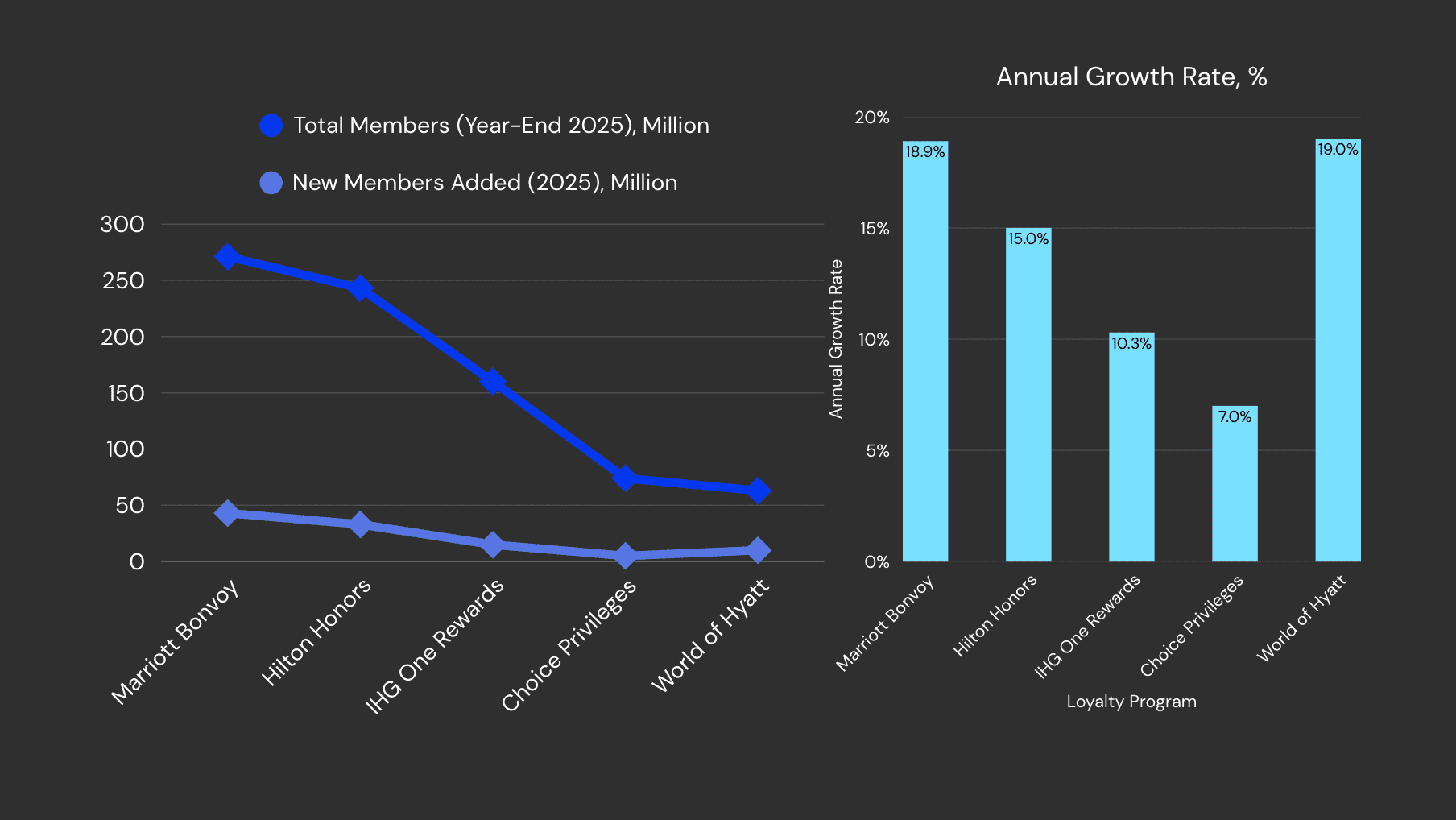
Let’s start with the hotel loyalty program statistics I’ve compiled. It will help you understand the marketing data and show what has actually changed in 2025–2026: which programs have grown the most, how many new members have been added, and which hotel groups have expanded their presence. In this comparison, we will benchmark the “big five” so you can quickly see who has grown in scale, who has gained momentum, and then I will analyze what these changes mean for the value of loyalty for travelers.
| Loyalty Program | Total Members (Year-End 2025), Million | New Members Added (2025), Million | Annual Growth Rate |
|---|---|---|---|
| Marriott Bonvoy | 271 | 43 | 18.9% |
| Hilton Honors | 243 | 33 | 15.0% |
| IHG One Rewards | 160 | 15 | 10.3% |
| Choice Privileges | 74 | 5 | 7.0% |
| World of Hyatt | 63 | 10 | 19.0% |
Key Insights from Official 2026 Filings
- Marriott Bonvoy: Remains the world’s largest loyalty program, ending 2025 with 271 million members. The program saw a massive surge, adding 43 million members in a single year, driven largely by the full integration of the MGM Collection and record-high “loyalty penetration,” with members accounting for 75% of room nights in the U.S. and Canada.
- Hilton Honors: Recorded a 15% year-over-year increase to reach 243 million members. Hilton reported that its membership growth was a primary driver for repeat business, with a new member joining the program approximately every 1.06 seconds during peak periods of 2025. In 2024, in the article Hotel Loyalty Program Statistics, we predicted that Hilton would take first place in terms of the number of program members, but this prediction did not come true. Currently, there is a significant gap between Hilton and Marriott, at 28M.
- IHG One Rewards: Surpassed the 160 million member milestone. The 2025 growth was bolstered by the launch of new brands like Garner and the acquisition of Ruby Hotels, which expanded IHG’s reach into the “lean luxury” and midscale conversion segments.
- World of Hyatt: Although the smallest of the “Big Five” by total count (63 million), it tied with Marriott for the highest percentage growth rate at 19%. Hyatt’s strategy remains focused on high-value travelers; the number of members staying 50+ nights per year increased by 13% in 2025.
- Choice Privileges: Ended 2025 with over 74 million members, a 7% increase. A standout statistic for Choice was its international enrollment, which grew by 11%, marking its strongest period of loyalty growth outside the U.S. to date.
Growth of the Chain’s Presence in the Global Hotel Industry in 2025–2026
Expanding the network, adding new brands, and opening new hotels.
| Hotel Groups | Brands added in 2025 – early 2026 | Brands/hotels |
|---|---|---|
| Marriott | Added: СitizenM, Series by Marriott, Outdoor Collection by Marriott Bonvoy; expanded midscale set (City Express / StudioRes / Four Points Flex). | Total brands: 41; Total hotels: 9,700+ properties (as of Sep 30, 2025); Added 700+ properties and nearly 100,000 rooms (2025). |
| Hilton | Outset Collection by Hilton (Oct 2025) and announced Apartment Collection by Hilton (Jan 2026). | Total brands: 26; Total hotels: 9,100+ properties (and 1.3M+ rooms) in 143 countries/territories; Added nearly 800 hotels and 100,000 rooms (2025). |
| Hyatt | Standard International (the integration of The Standard and Bunkhouse Hotels), Standard Residences (mid-2025), Hyatt Studios. | Total Brands: 33; Total Hotels in Portfolio: 1,528 hotels across 79 countries. Total Rooms: 335,000+ Rooms (officially released on February 19, 2026). In 2025, the portfolio grew by ~86 hotels. |
| Choice | In 2025, the company did not launch any completely new brand names, but carried out large-scale optimization and integration of existing assets: – Integration of Radisson – Leadership in Extended Stay (66 new hotels in the US under the brands WoodSpring Suites, Everhome Suites, and MainStay Suites) – The number of international rooms increased by 12.5% to ~160,000 units. Growth was particularly strong in France (15 new Comfort hotels) and Australia (launch of MainStay Suites). | Total brands: 22; Total number of hotels: 7,575 hotels in 50 countries and territories. Total room capacity: 656,825 rooms. 440 hotel openings in 2025. |
| IHG | Added: Noted Collection, Ruby Hotels, Vignette Collection | Total brands: 21; 443 hotels opened in 2025 (record) and 65.1k rooms opened. |
Major Changes to Loyalty Programs in 2025-early 2026
Marriott Bonvoy
Outline of the main changes to the Marriott Bonvoy loyalty program in 2025-2026:
- Marriott has improved its loyalty program for Executive Apartments, effective December 30, 2025. Marriott Bonvoy members now earn 5 points per $1 spent (instead of 2.5) and 1 elite night for every night stayed (instead of 1 per 3 nights). Executive Apartments are fully furnished apartments with kitchen facilities and hotel services in 16+ countries. The changes double the number of points and triple the elite nights, which significantly speeds up the process of obtaining status and accumulating points for free nights.
- Platinum Elite members and above continue to receive complimentary upgrades, but no longer “complimentary upgrades to the best available room,” according to View from the Wing. This is confirmed by the program’s policies and terms and conditions.
- The period for accruing points for stays at Marriott Homes & Villas villas and apartments is being reduced. Now you don’t have to wait three to six weeks; the period has been reduced to three days (72 hours). Source.
- All Renaissance Residences, Oahu hotels participate in the loyalty program.
- StudioRes is a Bonvoy brand but does not earn Elite Night Credits (source).
- Marriott’s terms note Sonder by Marriott Bonvoy stopped participating as of Nov 9, 2025, which affects both earning and redemption expectations for members who used those properties (source).
- Marriott’s own help center states that in early March 2026, members who did not re-achieve their status in 2025 are offered one tier below their current status through February 2027 (a “soft landing” style outcome).
Hilton Honors
Hilton has shifted its focus toward rewarding “power users” while simplifying the mid-tier path.
- New “Diamond Reserve” Tier: Launching in early 2026, this tier is earned via 80 nights or 40 stays + $18,000 in annual eligible spend, and introduces a Confirmable Upgrade Reward (confirm a premium room or suite upgrade at booking) plus guaranteed 4 p.m. late checkout, premium club access, and 120% bonus points (source).
- Lowered Hurdles for Gold/Diamond (effective Jan 1, 2026): Gold now requires 25 nights / 15 stays / $6,000 eligible spend, and Diamond requires 50 nights / 25 stays / $11,500 eligible spend (source).
- Qualification shifted from “Base Points” to “Eligible Spend” for status: Hilton explicitly notes the spend thresholds and frames this as replacing the older base-point qualification route (“was 75K Base Points” / “was 120K Base Points”) (source).
- The End of Rollover Nights: Hilton confirms rollover nights end beginning January 1, 2026. Nights earned in excess in 2025 can roll into 2026, but nights earned in excess in 2026 don’t roll into 2027 (source).
- Point Earn Adjustments at select brands (effective Jan 8, 2026): Hilton states that for point-eligible bookings made on or after January 8, 2026, Homewood Suites and Spark earn 5 Base Points per $1 (down from 10) (source).
World of Hyatt
Hyatt is moving away from its rigid award chart to better compete with more flexible pricing models, while still insisting it’s not going fully dynamic.
- Starting May 2026, Hyatt expands from 3 redemption levels (Off-Peak/Standard/Peak) to 5 levels: Lowest, Low, Moderate, Upper, Top within each category. Hyatt also says that in 2026 only a limited number of hotels will move a limited number of nights into Upper/Top, with broader adoption later (source).
- Digital Points Sharing (planned for later in 2026): Hyatt says “later this year, members will be able to share points digitally” (source).
- Early award access (new, later in 2026): Hyatt also announced early access to award night availability for Explorists, Globalists, Lifetime Globalists, and World of Hyatt Credit Cardmembers (Hyatt newsroom announcement, Feb 25, 2026)
- Milestone Rewards: “Guest of Honor” starting at 40 nights: Hyatt’s official Milestone Rewards page shows a Guest of Honor Award at 40 qualifying nights (or 65,000 base points) (source).
- What else to add (hgh-impact):
IHG One Rewards
IHG continues to double down on its “choose your own adventure” style of loyalty (Milestone Rewards + selectable benefits).
- Extended Lounge Access rule change (beginning 2025): IHG states that beginning in 2025, Annual Lounge Membership is valid for the remainder of the year after the milestone is achieved plus one full calendar year, regardless of when the member selects it (example given: achieved June 2025, selected Aug 2025 → valid until Dec 31, 2026) (source).
- Rollover Nights remain part of IHG One Rewards (and are shown as a published benefit): IHG’s own Benefits Chart still includes “Rollover Nights for Next Year’s Status” for Gold / Platinum / Diamond (source).
- Milestone Rewards structure clarity: IHG confirms Milestone Rewards are earned every 10 nights from 20 to 100, and at 40 and 70 nights, members can choose two Milestone Rewards options (where available) (source).
Choice Privileges
Here are the main changes to the Choice Privileges program that took effect in 2025:
- Award booking window extended to 50 weeks Choice has tripled the award night booking window to 50 weeks in advance (compared to the previous limit of ~100 days). Source: Choice press release.
- Points can be used for premium room amenities/upgraded room types Choice has introduced the ability to redeem points for premium amenities and premium room types (i.e., not just the basic/standard room options that were typically available before). Source: Choice press release.
- By the way, Choice RewardSaver is back choice has reintroduced Choice RewardSaver, a points exchange tool designed to provide better value for award night bookings (borrowed from the former Radisson Hotels Americas toolkit). Source: Choice press release.
- “More competitive point exchange rate”. Choice described the updates in early 2025 as including a more competitive point exchange rate as part of a broader positioning of a “brand new rewards experience.” Source: Choice investor news release.
- Expanded non-hotel redemption options highlighted in 2025 communications. Choice emphasized more ways to use points, including redemption at Preferred Hotels & Resorts (through Choice), as well as other redemption categories (e.g., gift cards/airline miles). Source: Choice investor news release.
Loyalty Points Devaluation (2025–2026)
In 2025–2026, “devaluation” ceased to appear as the only easily noticeable growth on the graph.
In essence, the points themselves did not lose their value, but the programs quietly closed loopholes, raised minimum requirements, and turned benefits into paid options, making the best value moments rarer and harder to access.
Let’s look at each program separately:
Marriott Bonvoy
In the past, even with dynamic pricing, program members could still find really low minimum thresholds, for example, a “category 5” hotel that could cost around 30,000 points during a quiet week in February. In 2025–2026, such minimum thresholds increasingly disappeared as Marriott’s algorithm kept reward prices more closely tied to high, post-inflation cash rates. Program members accepted this as the new normal: the “off-peak” period no longer seemed like a period of 30-40% discounts, and the points-to-cash ratio stabilized at a lower level (often around 0.7 cents per point in perceived value), making it much more difficult to find “unique” offers.
World of Hyatt
The story of Hyatt’s devaluation has two levels. By the way, the visible level is the transition to a more flexible reward price with additional redemption ranges. And the second level is the “category 8 trap.” During the rebalancing in March 2025, a significant number of high-demand properties moved up from category 6 to 7 or from 7 to 8. This may seem like a routine reclassification, but it directly affects one of Hyatt’s most motivating rewards: achievement-based free night certificates.
When prestigious hotels move to category 8, category 1-7 certificates earned for achieving important milestones suddenly lose their value. Members who have spent dozens of nights earning these certificates find that they aren’t valid at the very hotels that made their pursuit worthwhile. This is the dilution of milestones in practice: the certificate still exists, but the number of places where it’s truly valuable is decreasing as the top of the portfolio moves to a higher category.
IHG One Rewards
IHG’s devaluation is more subtle but perhaps more widespread: the headline “standard room reward” isn’t always more expensive; it’s just that the “standard room” has become a multi-tiered product.
With expanded attribute-based pricing, a room that includes “high floor” or “city view” can now cost an additional 2,000–5,000 points per night. Program members often find that the only rooms available at the base reward price are the least desirable (near the elevator, facing a wall), forcing them to “pay extra” with points for what used to be a normal standard reward.
This is classic soft devaluation: it isn’t announced as a change in the reward tables, but it systematically increases the number of points required to book the rooms that most travelers actually want.
Choice Privileges
After the full integration of Radisson Americas, many of Radisson’s former lucrative offers, including the elite Radisson Blu and Radisson Individual hotels, which previously cost in the range of 20,000-30,000, have moved to the 35,000-45,000 point range to match Choice’s pricing logic for elite hotels.
Overall Devaluation of “Guaranteed Upgrades” Due to Paid Upgrades on Standby
The most significant devaluation in 2026 may not even be related to points, it’s upgrades. As hotels increasingly use AI-based personalization, they’re also increasingly offering paid standby upgrades through apps. Mid-tier members may receive a push notification offering a suite upgrade for $50–100 shortly before check-in. This may seem like a nice option, but it fundamentally changes the economics of elite recognition.
When upgrades become a market, the supply of suites that were historically reserved for free elite upgrades is monetized at an earlier stage. Even if a Diamond or Titanium member is technically eligible for a free upgrade, the best suites may already be sold to those willing to pay for them. In other words, the benefit doesn’t disappear, it’s displaced.
Devaluation Has Become Structural
Marriott, Hyatt, IHG, and Choice (and increasingly across the industry) are seeing the same trend: fewer extreme deals, more predictable revenue, more monetization points, and for members, a shift in strategy from “collect and wait” to “earn widely, use quickly, and focus on benefits that can’t be quietly devalued.”
Conclusion
What conclusions can we draw based on the research we have conducted:
The total number of loyalty program members is growing rapidly (e.g., Marriott +43 million to 271 million; Hilton +33 million to 243 million; Hyatt +19% to 63 million), but CBRE macro statistics show that the average program member is less active (the number of nights per program member has decreased).
This is forcing hotel groups to rethink their loyalty programs to benefit from members who don’t stay at hotels frequently.
Loyalty is being redesigned to:
- retain casual members with simpler tiers,
- generate higher revenue from “power users,”
- monetize non-stay behavior (cards/partners/subscriptions),
- expanding presence in the global hotel arena, members can stay “in the network” more often. But this can also blur brand clarity and consistency if the loyalty experience isn’t standardized and personalized.
Hotel loyalty in 2025–2026 has changed not only the benefits but also the business model: programs are optimized to generate revenue per member rather than the number of members in the program, making elite recognition more valuable to frequent travelers and less predictable for everyone else.


