
Alaska Airlines Status Levels: The Complete Guide to Atmos Rewards Elite Status

PointsCrowd is a community-supported platform. When you apply for a credit card, make an order, or otherwise interact with the advertisers through the links on this page we may earn an affiliate commission. This helps us maintain and develop the platform further at no cost to you.
Alaska Airlines’ Atmos Rewards program, which now includes Hawaiian Airlines, has some of the most wanted status levels for frequent flyers in the U.S. If you want free checked bags, priority upgrades, or oneworld alliance perks, knowing how Alaska’s elite status works can really help you out and make your trips easier (and cheaper). But, because they’ve changed the program recently with new tier names and rules for earning status, you need to do more than just glance at the airline’s website to figure out how to get Alaska elite status and get the most from it.
This guide explains Alaska Airlines’ status levels in the Atmos Rewards program, what they mean, how to earn them, which perks are actually worth it, and what problems to watch out for. Whether you’ve always flown Alaska, love collecting points, or are just curious if elite status is worth it, you’ll find answers (and things you can do) here.
Key Concepts: Atmos Rewards, Status Points, and Elite Tiers
Before diving into earning and using Alaska Airlines status levels, let’s clarify the essential terms:
- Atmos Rewards Points is the main currency of the Alaska/Hawaiian loyalty program. Earned on flights, credit card spend, and partners, and redeemable for flights and other rewards. Not all points count toward elite status.
- Status Points (SP) is separate from redeemable points; status points are what actually move you up the status ladder. They’re earned on eligible flights, select credit card spend, and expire each December 31.
- Elite Status Tiers: Atmos Rewards has four levels — Silver, Gold, Platinum, Titanium — each requiring a higher annual status point total and unlocking progressively more valuable benefits (The Points Guy).
- Milestone Rewards it is perks you can select at certain status point milestones (starting at 10K), including upgrade certificates, lounge passes, and more.
- Lifetime Status (Million Miler): Reach 1,000,000 or 2,000,000 lifetime miles on Alaska/Hawaiian and you’ll get Gold or Platinum status for life.
How Alaska Airlines Status Levels Work in Atmos Rewards
Atmos Rewards status is all about racking up points each year. You get these points from flights (both paid and, starting in 2025, even award tickets), some partner activities, or when you use the right credit card. The more points you get, the better your status and the better the perks.
Keep in mind that not everything counts. You have to book the right fares and make sure to add your Atmos number to each booking. Watch out for exceptions, like super cheap tickets or some partner deals. The program wants to reward people who fly and spend regularly with Alaska, Hawaiian, and some partners – it’s not just about any old flight.
Whatever level you hit by the end of the year sticks for the rest of that year and all of the next one. So, if you hit Gold in July 2025, you get to enjoy those Gold perks all the way through December 2026.
Alaska Airlines Elite Status Tiers, Thresholds, and Benefits
Let’s start with a side-by-side comparison. This table summarizes the current Atmos Rewards elite status levels, their qualification requirements, and the core benefits you can expect.
| Tier | Status Points Needed (2025/2026) | Main Benefits | oneworld Mapping |
|---|---|---|---|
| Silver | 20,000 | Group B boarding, 2 free checked bags, 25% flight bonus, limited AA seat selection | Ruby |
| Gold | 40,000 | Group A boarding, 2 free bags, 50% bonus, upgrades (domestic), free AA Main Cabin Extra, AA upgrades | Sapphire |
| Platinum | 75,000 / 80,000 | Priority boarding, 3 free bags, 100% bonus, highest domestic upgrade priority, oneworld Emerald lounge | Emerald |
| Titanium | 100,000 / 135,000 | Top upgrade priority (incl. international), 3 free bags, 150% bonus, Alaska Lounge+ membership, premium snacks/meals | Emerald |
| Million Miler Gold | 1,000,000 lifetime miles | Lifetime Gold (no requalification), companion status benefit | Sapphire |
| Million Miler Platinum | 2,000,000 lifetime miles | Lifetime Platinum (no requalification), companion status benefit | Emerald |
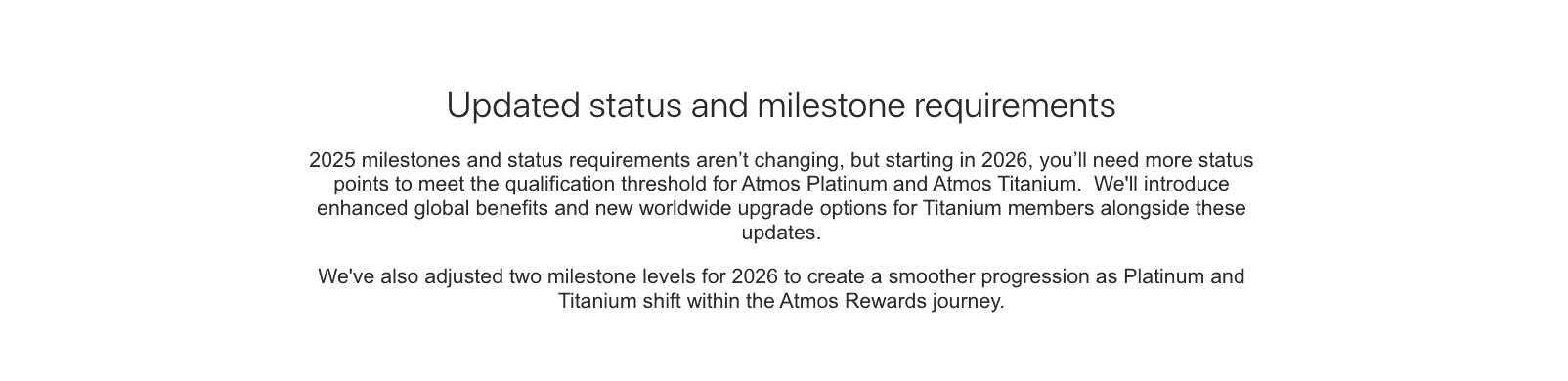
Thresholds increase for Platinum (80K) and Titanium (135K) in 2026.
All Ways to Earn Alaska Elite Status
Let’s break down the practical earning paths — each with its own nuances and caveats.
1. Paid Flights on Alaska, Hawaiian, Horizon, SkyWest
With Atmos Rewards, you get to choose how you rack up points towards your status. You can earn them based on how far you fly, how much you spend, or the number of flights you take. Just make sure to pick your preferred method at the start of each year.
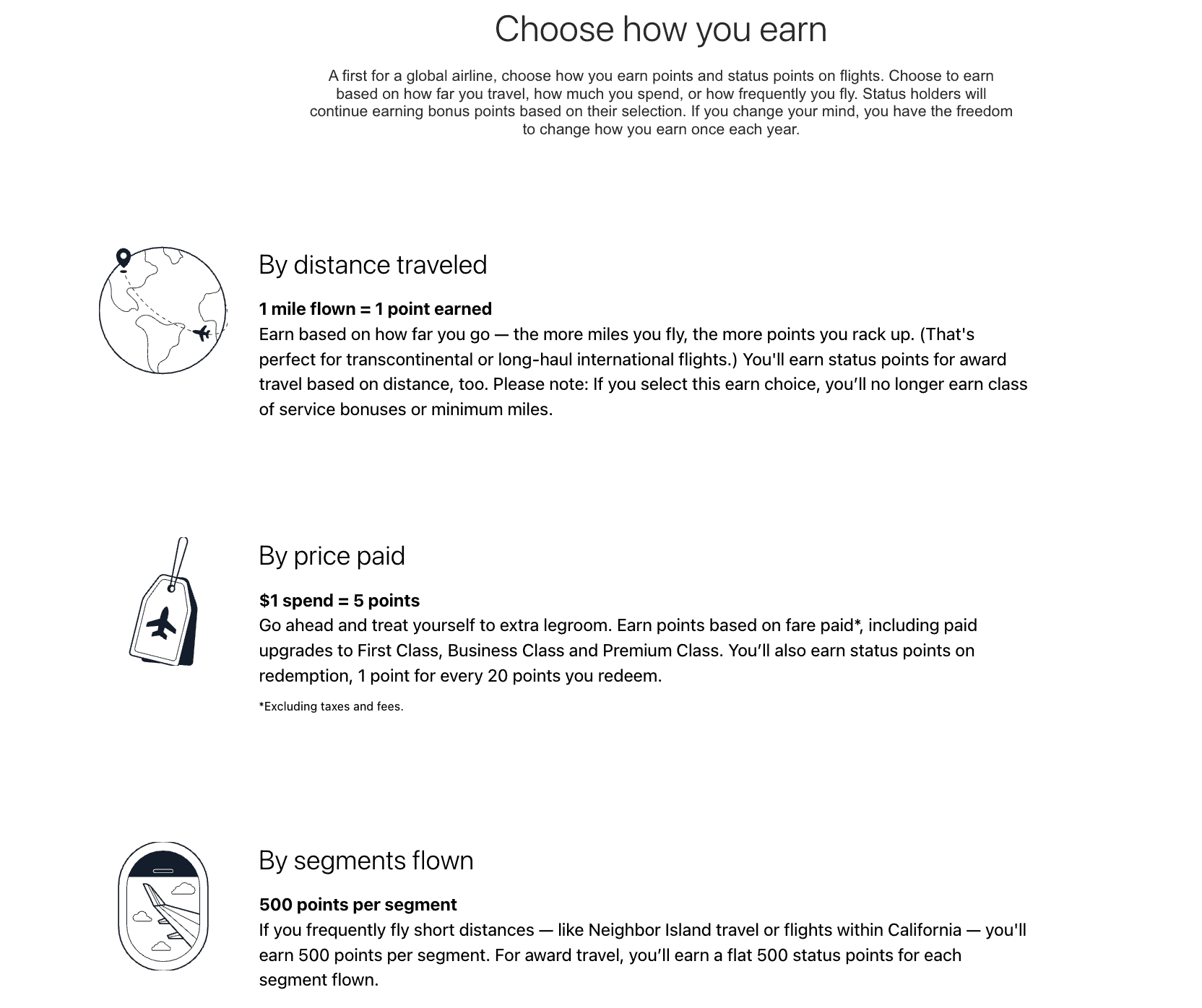
The bread-and-butter method. Eligible fares (excluding basic economy/X-class and some discounted tickets) earn status points by your chosen method (distance, spend, or segments). Always add your Atmos number at booking.
- Distance-based: 1 status point per mile flown (including award flights—see #2). Example: SEA–JFK (~2,421 miles) earns 2,421 status points per segment/day flown.
- Spend-based: 5 status points per $1 of base fare and paid upgrades (taxes/fees excluded). A $400 base fare earns 2,000 status points.
- Segment-based: 500 status points per flight segment. A two-segment trip earns 1,000 status points.
Points post after travel once your Atmos number is on the PNR. Your elite-status “counter” for the year reflects whichever mode you selected. (The choice applies to both redeemable points and status points once the feature goes live.)
| Earn mode | Exact accrual | Best for | Pros | Watch-outs |
|---|---|---|---|---|
| Distance | 1 status point per mile flown | Long-haul & transcons; award flyers | Simple; great on long flights; award tickets can earn status points | No cabin/class multipliers; pick once per year (you can change your choice once each calendar year) |
| Price | 5 status points per $1 in base fare & paid upgrades (taxes/fees excluded) | Short, pricey hops; premium-cabin cash fares | Rewards high spend; upgrades count | Zero status points on award tickets; need base-fare number (not total with taxes) |
| Segments | 500 status points per flown segment | Commuters & island hops (many legs) | Predictable—each leg pays the same | Worse value on simple nonstop long-hauls |
Pro Tips & Caveats
- Your earn mode choice (distance/spend/segments) is the lever — pick based on your pattern (long-haul economy → distance, pricey short-hauls or paid upgrades → spend, heavy commuters with lots of legs → segments). You can only change once mid-year.
- Partner accrual is nuanced: booking via Alaska generally yields better multipliers today; premium partner tickets booked direct improve later in 2026 (great for BA/JAL/QR premium cabins).
- Award flights are a real status tool — but only if you’ve selected a compatible earning mode (distance or segments).
- Card status points don’t replace flying for top tiers, but they meaningfully close gaps (Summit’s uncapped $2:$1 ratio + 10k boost is especially powerful).
Atmos Status Points Calculator
Heads-up for partner flights: Earning on partner tickets improves “later in 2026,” with premium cabins booked direct with partners earning up to 250% of distance (both status & redeemable points). That’s outside the simple calculator above.
2. Award Flights
Redeem Atmos points for a flight? Book flights with Atmos points and attach your Atmos number, and you’ll earn status points if your earning mode supports it:
- With distance-based selected: 1 status point per mile flown on award tickets (Alaska, Hawaiian, and partners). Example: LAX–HNL (~2,556 miles) award returns 2,556 status points.
- With segment-based selected: 500 status points per flown award segment (per TPG’s program summary).
- With spend-based selected: award tickets don’t have a fare, so assume 0 status points. Alaska also states broadly that members “can earn status points when they book award travel.”
But beware: not all award tickets (e.g., promo or companion tickets) qualify.
3. Partner Flights
You can earn both redeemable points and status points on partner airlines when your Atmos number is on the reservation. Two things to know:
- Booked via Alaska: today’s partner earn rates are strong (e.g., premium cabins can earn up to 350% of distance as redeemable + status points depending on cabin/fare).
- Booked directly with partners: historically weaker, but “later in 2026” premium-cabin partner tickets will earn a lot more—for example, international first up to 250% of distance vs ~150% today. That’s a meaningful bump to status points on pricey partner tickets.
How accrual posts: Partner flights typically post within a few days after travel. Your status-earning math follows the mode you chose for 2026 if the program specifies that for partner activity; otherwise partner tables apply (Alaska has said segment-based will earn per segments on partner tickets; distance/spend continue to use published charts).
4. Credit Card Spend
As detailed above, co-branded cards can be a powerful supplement — especially if you’re short on qualifying flights. But annual caps and exclusions mean you shouldn’t rely solely on this method.
- Atmos Rewards Summit Visa Infinite (premium): 1 status point per $2 in purchases + 10,000 status points every card anniversary. No cap on status points from spend. Example: $20,000 annual spend = 10,000 status points from spend + 10,000 anniversary = 20,000 total.
- Atmos Rewards Ascent Visa Signature (personal) & Atmos Rewards Visa Signature Business: 1 status point per $3 in purchases; capped at 30,000 status points from spend in 2025, uncapped in 2026. Example: $9,000 spend in 2025 = 3,000 status points; in 2026, caps go away.
We have detailed reviews of each credit card, so feel free to use them if necessary:
- Atmos Rewards Ascent Visa: The Rebranded Alaska Airlines Signature Card That Changes the Game
- Atmos Rewards Summit Card: The Premium Upgrade You’ve Been Waiting For
Status points from cards usually post after the statement closes; anniversary boosts post on or shortly after the anniversary date, per issuer terms.
5. Status Match Challenge
If you qualify, a status match can fast-track you to Silver, Gold, or Platinum, but you’ll need to complete a set number of eligible flights or status points within a defined window to keep it (Atmos Rewards Status Match). Not all partner flights count toward the challenge — double-check before booking.
6. Lifetime Status
For lifetime status, fly 1,000,000 miles (Gold) or 2,000,000 miles (Platinum) on Alaska/Hawaiian flights. Once unlocked, you never need to requalify.
Monitor Your Progress
You need to reach the following status point totals by December 31 each year:
- Silver: 20,000
- Gold: 40,000
- Platinum: 75,000 (2025) / 80,000 (2026)
- Titanium: 100,000 (2025) / 135,000 (2026)
To see how you’re doing in the Alaska Airlines Atmos Rewards program, just check your account on their website or app.
Here’s what you can keep an eye on:
- Bonus points: You can use these for flights and other cool stuff.
- Status points (SP): These points don’t get you freebies, but they help you move up the ladder to elite status levels like Silver, Gold, Platinum, and Titanium. Reaching these levels can get you Milestone Rewards.
- Status/bonus tracking: If you’re trying to reach a new status or earn a credit card bonus, there might be a special tracker in your account to show how close you are.
Keep in Mind: Points from flights usually show up fast. Credit card points might take a bit longer and show up all at once at the end of the month.
Status is valid for the rest of the year you qualify and all of the next.
Elite Status Benefits

Alaska Airlines status has some cool benefits, but some are way better or easier to get than others.
Priority Boarding
If you have elite status, you get to board before everyone else. Silver members board with Group B, Gold with Group A, and Platinum/Titanium get into the Priority group. This means you’re more likely to find space for your bag, and the whole boarding thing won’t be as stressful. If you’re traveling with family or have a lot of bags, it can save you time.
Free Checked Bags
Silver and Gold members usually get two free checked bags for each person. Platinum and Titanium members get three. This could save a couple traveling around 60–60–120 on a round-trip. One thing to remember: if you want your travel buddy to get their bags for free, you all need to be on the same reservation and not part of a group booking.
Bonus Points on Flights
You can get 25%–150% more points for flights, depending on your status. This helps you get award flights faster. Just keep in mind that these bonus points don’t count toward your elite status.
Upgrades

If you’re Gold, Platinum, or Titanium, you might get a free upgrade to Premium or First Class on Alaska flights if there are seats open. Gold members and one companion can get upgrades up to 72 hours before the flight. Platinum and Titanium get first dibs on upgrades too. Titanium members will get priority for international upgrades starting in 2026. Keep in mind those upgrades don’t work if you bought the basic economy or X-class tickets. If you change your flight after getting upgraded, you might lose the upgrade.
Same-Day Flight Changes
Gold members and above can switch to an earlier or later flight on the same day without a fee, but only if you have a Main Cabin or First Class ticket. This is great for business travelers or anyone whose plans change suddenly.
Lounge Access

Titanium members get Alaska Lounge+ access and can bring guests. Platinum members can bring one guest to partner lounges. Gold and Silver members don’t get lounge access just from their status. So, if you like chilling out before your flight, this could be a big deal.
Rewards
Every 10,000–30,000 status points, you can get a reward. You can pick from bonus points, lounge passes, Wi-Fi, or upgrade certificates. You can use these to make your trip better, but only if you earned enough points. Status matches don’t count for these rewards.
American Airlines and oneworld Benefits
Gold members and up can pick Main Cabin Extra seats for free and might get upgraded on domestic American Airlines flights. Platinum/Titanium status also gets you perks like first-class lounge access on international flights. Keep in mind that upgrades are limited and depend on the rules of the partner airline.
How to Maximize Value from Alaska Elite Status
To really get the most from Alaska Airlines status, think about how you earn and spend your miles. Here’s how to make things work for you:
- Match your earning style to how you usually travel. If you take lots of short trips, earning status based on segments (starting in 2026) could be a great deal. If you fly long distances or spend a lot, earning based on miles flown or dollars spent might be better.
- Use your credit card to earn miles, but don’t depend on it completely. The Summit Visa is great if you spend a ton because there’s no limit to how many miles you can earn. If you have an Ascent card, remember you can only earn 30,000 points each year. Keep an eye on your spending so you don’t miss out.
- If you want to take advantage of the status match, time your status match carefully. Apply between July and December to keep your status until the end of the next year.
- Choose your milestone rewards ASAP. When you reach a milestone (like 10,000, 30,000, or 55,000 miles), pick your reward quickly in your account. They don’t roll over automatically, and bonus points aren’t always automatic.
- Book your flights the right way. To make sure you get your status points, always book flights through alaskaair.com or the Alaska app, especially when flying with partner airlines.
- Make sure your plans are set before asking for upgrades. Changing your flight after you’ve been upgraded can cancel the upgrade.
Is Alaska Elite Status Worth It? Who Should Pursue It?
If you often fly Alaska or Hawaiian, especially if you’re paying for your tickets, getting elite status can save you a good chunk of change. We’re talking hundreds or even thousands of dollars because of things like waived fees, upgrades, and perks with partner airlines. The real sweet spot is Gold status or higher – that’s when you start getting free upgrades, lounge access, and recognition with the oneworld alliance.
If you only travel now and then, or just fly a few times a year, Silver status is okay. You get some nice things like free checked bags and boarding a bit earlier. But it might not be worth the effort unless you can also spend a lot on a credit card to help you get there.
Now, if you already have elite status with another airline, you might be able to match that status with Alaska or Hawaiian. It can be a quick way to get benefits, but only if you’re willing to put in the work to meet their requirements.
Don’t even bother trying for status if:
- You usually fly basic economy or really cheap tickets.
- You mostly book your flights through websites like Expedia, Kayak, and other.
- You don’t think you can earn at least 20,000 status points, even with credit card spending.
Bottom Line
If you fly Alaska Airlines a lot, their Atmos Rewards program can be really rewarding, but only if you know how it works. To get the most out of it, concentrate on flights that count towards status and use the right credit cards. Keep an eye on your progress and be sure to actually use the perks you earn. Plan a bit, and you can get upgrades, avoid fees, and just have a better time when you travel.


