
PointsCrowd is a community-supported platform. When you apply for a credit card, make an order, or otherwise interact with the advertisers through the links on this page we may earn an affiliate commission. This helps us maintain and develop the platform further at no cost to you.
Two families want to combine points for the same trip. One logs into United and pools miles for free in about five minutes. The other logs into Delta and finds out moving miles to a relative costs a penny each, plus a flat $30 fee, whether they transfer 1,000 miles or 30,000. Same idea, wildly different programs. Family pooling and points transfers work nothing alike across US airlines and hotel programs, and assuming your favorite program’s rules apply everywhere else is the fastest way to overpay or hit a wall.
In this article, you’ll discover:
- Which programs let you pool points for free, and which charge per point to move them
- The exact fees, limits, and family-size caps for every major US airline and hotel program
- Which programs don’t allow transfers at all — and what to do instead
- A side-by-side value comparison so you can see which route actually costs less
- Answers to the questions families ask most about combining points
Airline Programs Compared
| Program | Family Pooling? | Cost | Key Limit |
|---|---|---|---|
| United MileagePlus | Free pooling, up to 5 members | Free | Unlimited contributions; pooled miles only redeemable on United (not partners) |
| JetBlue TrueBlue | Free Points Pooling, 2-7 members | Free (pooling); fee applies for direct transfer | Pool leader must be 21+; kids under 13 can join via a parent |
| Frontier Miles | Free family pooling, up to 8 members | Free | Primary holder needs Elite Silver status or the Frontier World Mastercard |
| American AAdvantage | No pooling — paid transfer only | $0.005/mile ($5 per 1,000) | 200,000 miles out and 200,000 in per member, per year |
| Delta SkyMiles | No pooling — paid transfer only | $0.01/mile + $30 processing fee per transaction | 150,000 out / 300,000 in per year; max 30,000 miles and 4 recipients per transaction |
| Alaska / Atmos Rewards | Free sharing up to 10 people — Summit Visa cardholders only | Free with the card; otherwise $10/1,000 points + $25 fee | Non-cardholders pay full price per transfer |
| Southwest Rapid Rewards | No pooling of any kind | ~$10 per 1,000 points | Transfer value drops to roughly a third of face value; booking in someone else’s name is free |
Hotel Programs Compared
| Program | Family Pooling? | Cost | Key Limit |
|---|---|---|---|
| World of Hyatt | Free transfer to anyone, no relation required | Free | Once every 30 days (sending or receiving); each transfer adds 24 months to point expiration |
| Marriott Bonvoy | Free member-to-member transfer | Free | 100,000 out / 500,000 in per year; 1,000-point minimum and increment |
| Hilton Honors | Free pooling, up to 11 people, or 1:1 transfer | Free | 500,000 out / 2,000,000 in per year combined; max 6 transfers + 6 pool contributions/year |
| IHG One Rewards | Standard members: paid transfer only; Diamond Elite/Business Rewards: free | $5 per 1,000 points (standard); free for top tiers | 500,000-point annual cap either way; 30-day account age minimum |
| Choice Privileges | Not yet available | — | Member-to-member transfer is rolling out starting March 2026 |
| Wyndham Rewards | Not available at all | — | No member-to-member transfer exists; book the stay in the other person’s name instead |
Airlines: What Pooling and Transfers Actually Look Like

United MileagePlus: The Most Generous Free Pool — With a Catch
United’s mileage pooling lets up to 5 people combine miles into one account for free, with no cap on how much anyone contributes and no fee for setting it up. United was also the first of the “Big Four” US carriers to launch a real pooling feature, back in March 2024, which put pressure on competitors to follow.
The catch is real, though: miles sitting inside a pool can only be redeemed for United-operated flights. Star Alliance partner awards — which is where a lot of the best business-class availability actually lives — are off the table as long as the miles stay pooled. For a family hoping to book Star Alliance business class to Europe, that restriction can turn a pool full of miles into a pool full of frustration when United’s own award space comes up empty.
There’s a real workaround, though, and one PointsCrowd community member documented exactly how it works: if a member leaves a pool, their miles stay in the pool; but if the pool leader closes the pool entirely, the remaining miles get redistributed equally back into each remaining member’s individual account. Once the miles are back in an individual account, the partner-flight restriction no longer applies — they can be used for Star Alliance bookings like any other MileagePlus miles. In that specific case, the traveler left the pool, had the leader close it, and used the redistributed miles to book Swiss and Lufthansa business class to Rome that United’s own inventory couldn’t offer.
This isn’t an official feature Chase or United advertises, so treat it as a documented workaround rather than a guaranteed process, and remember pooled contributions can’t be pulled back individually — closing the whole pool is the only route out.
JetBlue TrueBlue: Free Pooling, Smaller Group, No Partner Restriction
JetBlue’s Points Pooling covers 2 to 7 members for free, and children under 13 can join through a parent or guardian’s account. Unlike United, JetBlue doesn’t restrict pooled points to JetBlue-operated flights only, which makes the pool meaningfully more flexible for the redemptions it does support.
When you book an award with a pool active, JetBlue draws from the traveler’s individual balance first, then pulls the remainder from the shared pool automatically. A family of three with 18,000, 11,000, and 7,000 points individually — none of them enough alone for a 32,000-point award — can combine to 36,000 and book without paying a cent in transfer fees.
Skip the separate paid-transfer option unless the recipient genuinely can’t or won’t join a pool; pooling avoids the fee entirely and is the better default for most families. Keep in mind the pool leader must be at least 21, and once someone leaves or is removed, that seat in the pool stays empty for six months.
Frontier Miles: The Biggest Pool, With Elite-Status Strings Attached
Frontier’s family pooling allows up to 8 people total — 1 primary account holder plus 7 contributors — making it tied with JetBlue for the largest pool size among major US carriers. The catch is eligibility: the primary account holder has to already hold Elite Silver status (earned via 10,000 qualifying points in a calendar year) or carry the Frontier Airlines World Mastercard. Contributors themselves don’t need status to join.
The primary holder has full control — they can redeem pooled miles without asking contributors first, and can remove anyone from the pool at any time. Redemptions draw from the combined balance on a first-in, first-out basis. One quirk worth knowing: pooled balances don’t get a shared expiration date. Each contributor’s miles still expire based on that person’s own 12-month activity window, except for contributors under 18, whose miles inherit the primary holder’s expiration date instead. If a contributor goes quiet for 12 months, their specific miles expire out of the pool even while everyone else’s stay active.
Frontier’s route network is smaller than United’s, Delta’s, or American’s, which limits how far pooled miles actually stretch for premium international redemptions. But for domestic and Caribbean/Mexico trips within Frontier’s network, the combination of free pooling and an 8-person cap makes it one of the more generous programs on this list — as long as someone in the group already has Silver status or the co-branded card.
American AAdvantage: Pay Per Mile, No Pooling
AA has no pooling feature — the only option is a paid transfer at $0.005 per mile ($5 per 1,000), in 1,000-mile increments, capped at 200,000 miles sent and 200,000 received per member each year. Transfers post quickly, usually within about 4 hours, but they’re final once submitted.
For most families, transferring is the wrong first move. AAdvantage lets you book an award ticket directly in someone else’s name from your own account at no extra cost — same-day availability, no fee, no annual cap to track. The math only favors an actual transfer when the recipient needs the miles in their own account specifically, such as topping off a balance they’re about to redeem themselves, or when you’re racing to lock in a partner award before it disappears.
Either way, transferred AA miles don’t earn Loyalty Points and don’t count toward Million Miler status, so treat a transfer as a one-way logistics move, not a way to build someone else’s account long-term.
Delta SkyMiles: The Most Expensive Way to Move Miles
Delta charges $0.01 per mile plus a flat $30 processing fee per transaction, with a 30,000-mile cap per single transfer and a 150,000-mile annual sending limit (recipients can take in up to 300,000 a year, from up to 4 senders per transaction). Both accounts need to be at least 10 days old with one automatically posted mile before a transfer is allowed.
Run the math on a routine 20,000-mile transfer: 20,000 × $0.01 = $200, plus the $30 flat fee = $230 total. That’s real money to move miles you could otherwise use, for free, by booking the award directly in the recipient’s name from your own SkyMiles account. Delta also offers a separate “gift miles” option with its own pricing tiers, but it’s built for buying miles as a gift, not for combining an existing family balance, and it’s rarely the cheaper path either.
If you’re debating whether to transfer at all, ask first whether the recipient actually needs the miles sitting in their own account, or whether they just need to get on a specific flight — the second scenario is free to solve without touching the transfer system.
Alaska / Atmos Rewards: Free, But Only With the Right Card
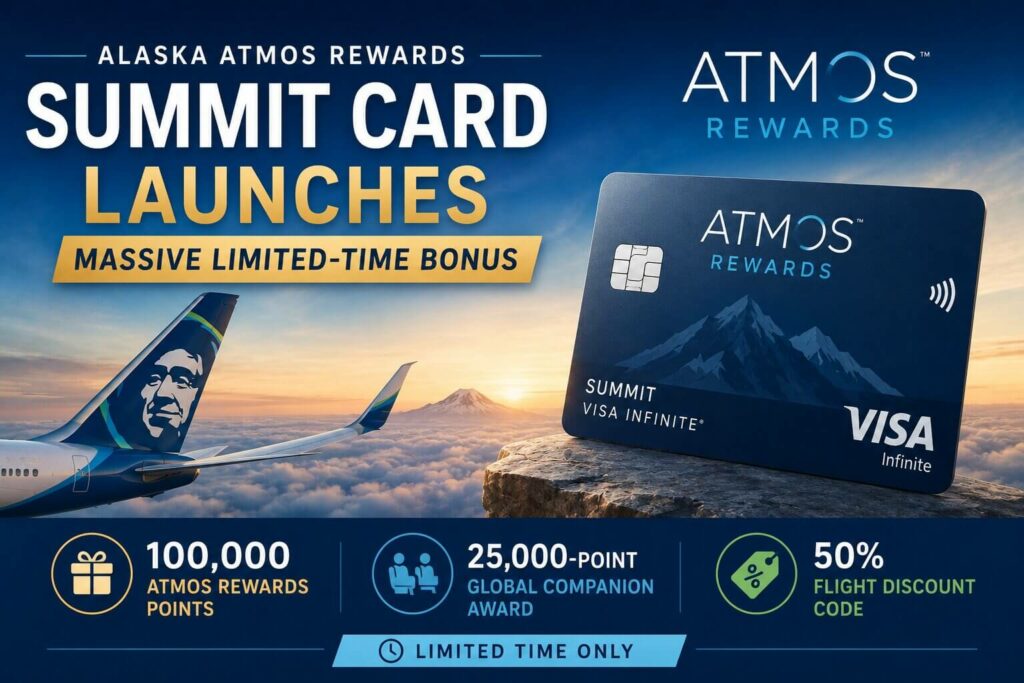
Atmos Rewards sharing is free for up to 10 people, but that free tier is gated behind the Alaska Airlines Summit Visa Signature card — the primary cardholder gets “Free Points Sharing” as a card benefit, not as a standard program feature available to everyone. Multiple family accounts can also combine points toward the same reservation, which is useful when several relatives are each chipping in toward one big award.
Without the card, the math changes fast: transfers cost $10 per 1,000 points plus a $25 processing fee per transaction, among the steepest per-point costs of any program in this comparison. On a 20,000-point transfer, that’s $200 plus $25 — $225 total, not far off Delta’s pricing despite Alaska/Atmos being a smaller, more regional program. Points typically post within about 72 hours of a paid transfer.
If your family flies Alaska or Hawaiian regularly, the Summit card pays for the free-sharing benefit alone if you’d otherwise be paying transfer fees every year. If nobody in the family holds it, lean on booking awards directly in each other’s names instead of paying to move points around.
Southwest Rapid Rewards: No Pooling, Period
Southwest doesn’t offer any form of point pooling or combining between accounts — member accounts are strictly individual, and Southwest’s own terms explicitly prohibit pooling or combining points across members. Paid transfers exist as a workaround, running roughly $10 per 1,000 points, but that pricing cuts the effective redemption value of your points by about two-thirds compared to using them yourself.
The better play on Southwest is almost always to book the award directly in a family member’s name from your own account during checkout — the points come out of your balance, but the ticket and boarding pass are issued in their name, with no transfer or fee involved. And for families who fly Southwest often, the Companion Pass dwarfs anything a points-pooling feature could offer: earn it once, and a designated companion flies free (taxes and fees only) on every Southwest flight you book for the rest of that year plus all of the next one.
Hotels: What Pooling and Transfers Actually Look Like

World of Hyatt: The Most Flexible Program, Full Stop
Hyatt places almost no restrictions on who you send points to — no family relationship required, no shared address, and no fee of any kind. You can combine points with a sibling, a friend, or anyone else with a World of Hyatt account, using nothing more than a PDF form emailed to [email protected] with both accounts’ details.
The only real limit is frequency: you can combine points once every 30 days, whether you’re sending or receiving, so it’s not built for rapid back-and-forth transfers between the same two accounts. As a genuinely useful bonus, every combine transaction extends both the sender’s and the recipient’s point expiration by 24 months — a side benefit that can rescue a balance that was about to expire anyway.
Because there’s no stated cap on the amount you can move, Hyatt is the program to reach for when one family member needs a large top-up for a high-category property. The tradeoff is the manual, form-based process — it’s not an instant, self-service transfer like Marriott’s.
Marriott Bonvoy: Free, Fast, and Simple
Marriott allows free member-to-member transfers to anyone with a Bonvoy account — Marriott dropped its old same-address requirement years ago, so the recipient doesn’t need to be family or even live nearby. Transfers move in 1,000-point increments online, and unlike Hyatt’s manual form, this one is self-service through the Marriott website or app.
You can send up to 100,000 points a year and receive up to 500,000 — limits generous enough that most families will never bump into them. Both accounts do need to be at least 30 days old with some earning or redemption activity (or 90 days old if there’s been no activity at all), so a brand-new account can’t receive a transfer on day one.
Common real-world uses: combining points with a partner for a shared award stay neither of you could book alone, sending a few thousand points to a family member who’s short for a specific redemption, or moving points to someone with elite status so the whole group benefits from their upgrades and late checkout during a joint trip.
Hilton Honors: Pooling or Direct Transfer, Your Choice
Hilton is one of the only programs on this list offering two distinct free options: pool points with up to 10 contributors under one organizer, or send a straightforward 1:1 transfer to a single person. Both work in 1,000-point increments, and Hilton charges no fee for either.
The combined annual ceiling covers both tools together: 500,000 points sent and 2,000,000 received per calendar year, with a hard cap of 6 outgoing transfers plus 6 pool contributions annually. To use either feature, your account needs at least a month of history with some activity (or 90 days if the account has been completely dormant), and a 1,000-point minimum balance to participate.
Pooling shines for a specific scenario: stacking enough points onto one account to book 5 consecutive nights and trigger Hilton’s 5th-night-free benefit, effectively a 20% discount that only kicks in when the full stay is booked from a single balance. It’s also the more approachable route when you’re eyeing a higher-category property that’s out of reach for any one person’s balance alone.
IHG One Rewards: Free If You’re Elite, Paid If You’re Not
Standard IHG members pay $5 per 1,000 points to transfer, in 1,000-point increments, with both accounts needing to be at least 30 days old. Diamond Elite members (70 qualifying nights or 120,000 qualifying points a year, or $40,000 spent on an IHG co-branded credit card) and IHG Business Rewards members transfer the exact same amounts completely free, up to a 500,000-point annual cap either way.
That fee gap is significant: moving 20,000 points costs a standard member $100, while an elite member pays nothing for the identical transaction. If you’re a frequent IHG guest sitting just under Diamond, it’s worth checking whether a slightly higher spend or a few more qualifying nights this year would unlock free transfers going forward, especially if pooling with family is a recurring need rather than a one-time thing.
There’s also an unofficial free workaround worth knowing about: some travelers with an IHG co-branded credit card have been able to pool points for free by contacting IHG customer support directly, though this isn’t a widely advertised or guaranteed feature — worth a phone call before paying the standard transfer fee.
Choice Privileges: Coming in 2026
Choice currently has no way to transfer or pool points between members at all — if you want to combine balances today, you can’t. That changes starting March 2026, when Choice launches member-to-member transfer as part of a broader program overhaul.
Full terms weren’t published at the time of writing, so treat any fee or limit you see elsewhere as provisional until Choice confirms the details on its own site. If your family relies on Choice properties, it’s worth checking back closer to the March 2026 rollout before assuming the terms will match any other program on this list.
Wyndham Rewards: No Transfer Option Exists
Wyndham doesn’t support member-to-member point transfers in any form — not a pool, not a paid transfer, nothing. It’s one of the more restrictive major hotel programs on this specific benefit.
The workaround is the same one that works when other programs charge steep fees: redeem your own points for a free night or discounted stay and book it directly in another person’s name. Wyndham explicitly permits designating any member as the guest on an award booking, so the points never actually need to leave your account for a family member to benefit from them.
Quick Value Math: Moving 20,000 Points, Program by Program
Same amount, wildly different cost. Here’s what it takes to move 20,000 points or miles to a family member’s account across the programs above:
- United, JetBlue, Frontier, Marriott, Hilton, World of Hyatt: $0 — free pooling or transfer.
- American AAdvantage: $100 (20,000 × $0.005/mile).
- IHG One Rewards (standard member): $100 (20,000 × $5 per 1,000).
- Alaska/Atmos (non-cardholder): $225 (20,000 × $10 per 1,000, plus $25 fee).
- Southwest Rapid Rewards: roughly $200, and the points lose about two-thirds of their redemption value in the process.
- Delta SkyMiles: $230 (20,000 × $0.01/mile, plus $30 flat fee).
The pattern holds across nearly every program on this list: if a free pooling or transfer feature exists, it’s almost always cheaper to use it than to book separately. If it doesn’t exist, booking the award directly in the other traveler’s name — skipping the transfer altogether — is usually the better move than paying a per-point fee.
Pro Tips
- Check for a “book in their name” option before paying any transfer fee. AA, Delta, Southwest, and Wyndham all let you redeem your own points for someone else’s trip at no extra cost — the fee only applies if you actually move the points.
- Watch account-age and activity requirements. Hilton, Marriott, IHG, and Delta all require the sending or receiving account to be a minimum number of days old with some activity — a brand-new account can’t always receive a transfer immediately.
- Don’t assume pooling is fee-free everywhere or unlimited once it exists. United and JetBlue pooling are genuinely free with no per-transaction cost; Hilton pooling is also free but capped at 6 contributions a year, and Frontier requires the primary holder to already have status or the co-branded card — check the specific program’s eligibility, not just whether pooling exists in general.
- If your pooled miles are stuck with no availability, check whether closing the pool helps. United’s pooled miles are locked to United-operated flights, but closing the pool redistributes miles back into individual accounts, where partner-airline restrictions no longer apply.
- If you’re an elite member, re-check your program’s transfer terms. IHG Diamond Elite and Business Rewards members transfer for free where standard members pay $5 per 1,000 points — status can eliminate a fee entirely.
- For Hyatt, time transfers around the 30-day window. Since you can only combine points once every 30 days each direction, plan ahead if you’re coordinating a booking with a deadline.
Bottom Line
Family pooling isn’t a standard feature — it’s a patchwork. United, JetBlue, Frontier, Marriott, Hilton, and World of Hyatt all let you combine points with family for free (though each attaches its own eligibility rules, group-size caps, or redemption restrictions), while American, Delta, Southwest, and (for now) Wyndham either charge steep per-point fees or don’t allow transfers at all. Before moving a single point, check whether your specific program lets you book directly in someone else’s name instead — in most cases, that’s free no matter which program you’re in, and it skips the transfer question entirely.
Frequently Asked Questions
Which loyalty programs let you pool points with family for free?
United MileagePlus (up to 5 people), JetBlue TrueBlue (2-7 people), Frontier Miles (up to 8 people), Hilton Honors (up to 11 people), Marriott Bonvoy, and World of Hyatt all offer free pooling or transfers with no per-point fee.
Which programs charge the most to transfer points to a family member?
Delta SkyMiles is the most expensive at $0.01 per mile plus a flat $30 processing fee. Alaska/Atmos Rewards (for non-cardholders) and Southwest Rapid Rewards also charge roughly $10 per 1,000 points.
What do you need to use Frontier's family pooling?
The primary account holder needs to already have Elite Silver status (earned via 10,000 qualifying points in a calendar year) or hold the Frontier Airlines World Mastercard. Contributors joining the pool don't need any status themselves. Once eligible, pooling up to 8 people is free.
Can I use my points to book a flight or hotel for someone else without transferring?
Yes, on nearly every program. You can redeem your own points or miles for an award booked in another person's name at no extra cost — this avoids transfer fees entirely on American, Delta, Southwest, and Wyndham.
Can United's pooled miles be used on partner airlines like Lufthansa or Swiss?
Not while the miles are inside the pool — pooled United miles are restricted to United-operated flights only. A documented workaround exists: if the pool leader closes the pool entirely, the remaining miles redistribute back into each member's individual account, and the partner-airline restriction no longer applies once they're out of the pool.
Does Southwest Rapid Rewards allow family pooling?
No. Southwest doesn't offer any form of point pooling or combining between accounts. Paid transfers exist but reduce point value by roughly two-thirds; the Companion Pass is a better family benefit than any transfer option.
Can Wyndham Rewards or Choice Privileges points be transferred to another member?
Wyndham does not support member-to-member transfers at all. Choice Privileges currently has no transfer option either, but is launching one starting March 2026.