Redeem Points On American Airlines: Save On Travel Costs

PointsCrowd is a community-supported platform. When you apply for a credit card, make an order, or otherwise interact with the advertisers through the links on this page we may earn an affiliate commission. This helps us maintain and develop the platform further at no cost to you.
Ever pulled up a one-way American Airlines fare, watched the price sit at $412, then flipped over to the AAdvantage search and found the exact same seat for 7,500 miles and $5.60 in taxes? That’s the moment most travelers realize their AAdvantage miles aren’t just a number sitting in an app — they’re a currency with a real, calculable value, and some redemptions are worth five times more than others.
Here’s the catch: American Airlines hasn’t used a simple, fixed award chart for its own flights in years. Pricing moves with demand, route and date, which means the difference between a “meh” redemption and a genuinely great one comes down to knowing where to look. This guide breaks down exactly how AAdvantage pricing works, the sweet spots worth chasing, which credit cards actually get you into the program, and the redemptions that quietly waste your miles.
In This Article, You’ll Discover
- How American Airlines actually prices award flights — and why there’s no single “award chart” anymore for AA-operated routes
- The exact cents-per-mile math to separate a good redemption from a bad one
- The AAdvantage sweet spots seasoned points collectors book first, with real mile costs by route and cabin
- Which credit cards actually transfer to AAdvantage in 2026 (spoiler: it’s not Chase or Amex)
- The non-flight redemptions that quietly waste your miles
- Common mistakes that cost AAdvantage members real value
What “Redeeming AAdvantage Miles” Actually Means
AAdvantage is American Airlines’ loyalty program, and miles earned through flying, co-branded credit cards or transfer partners can be redeemed — spent — on award flights, upgrades, and a shrinking list of non-flight perks. To redeem, you need an active AAdvantage account with enough miles to cover the redemption you want, plus enough cash on file to cover taxes and fees, because award tickets are never entirely “free.”
A lot of people assume American still runs on a published award chart, the kind where a business-class seat to Europe always costs the same number of miles. It doesn’t — not for flights American operates itself. That’s the single most important thing to understand before you redeem a single mile.
How American Airlines Prices Award Flights (Dynamic Pricing, Explained)
American Airlines adopted dynamic pricing for its own operated flights, meaning the number of miles a seat costs shifts with demand, route and travel date — the same way cash fares do. Search the same route two weeks apart and you’ll often see two very different mile prices for the identical flight.
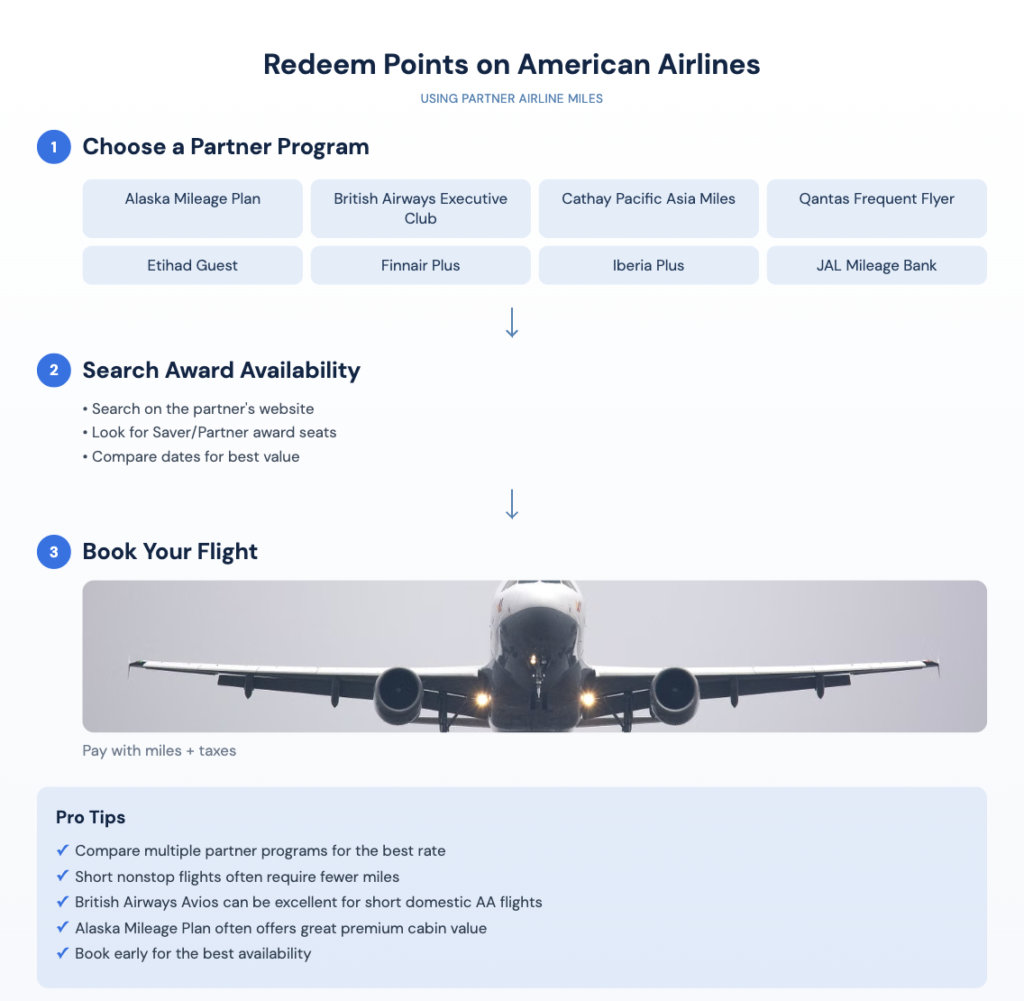
Partner awards work differently. Flights booked on American’s Oneworld partners — British Airways, Qatar Airways, Japan Airlines, Qantas, Cathay Pacific, Finnair, Iberia — and select non-alliance partners like Etihad still follow a published, region-based award chart. In practice, that means: expect volatility when booking American-operated flights, and expect predictability when booking partner-operated ones.
| Redemption type | Pricing model | Typical starting cost |
|---|---|---|
| American-operated domestic flights | Dynamic (varies by demand/date) | From ~7,500 miles one-way, economy |
| American-operated domestic first class | Dynamic | From ~15,000 miles one-way |
| Partner-operated international flights | Fixed, region-based chart | From 57,500 miles one-way, business class to Europe |
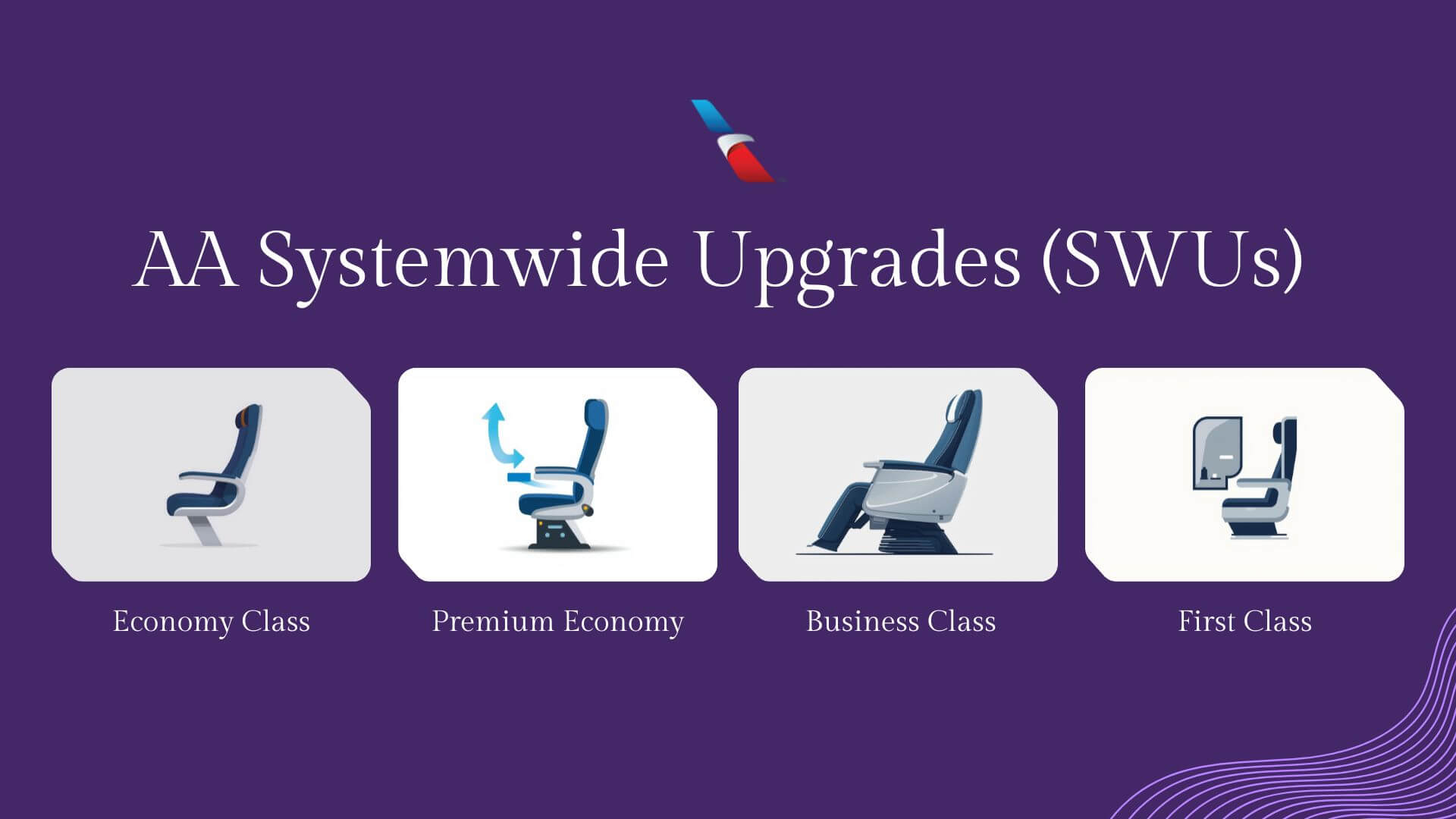
| Flight upgrades | Dynamic | From ~5,000 miles, shorter routes (elites often use Systemwide Upgrades instead) |
What Is a “Web Special” Award?
You’ll see this label pop up on some American-operated searches: a Web Special is AA’s own discounted-mileage inventory, released to nudge bookings on flights with soft demand. This is where those eye-catching 7,500-mile one-way domestic fares usually come from — it’s not a permanent price, it’s a promotional layer sitting on top of dynamic pricing. Note that Web Specials show up unannounced and disappear the same way, so if you spot one on your route, it’s worth booking rather than waiting.
How to Redeem American Airlines Miles for a Flight (Step by Step)
- Log in to your AAdvantage account on aa.com or in the app.
- Search your route and check the box labeled “Redeem miles” before hitting search — skip this and you’ll only see cash fares.
- Stay flexible on dates. Because pricing is dynamic, shifting a search by even a day or two can change the mile cost significantly. Use the calendar view to scan a wider window at once.
- Review the full breakdown — cabin, routing, layovers, and the miles-plus-fees total — before you commit.
- Check out with a card on file to cover taxes and fees. Miles get deducted automatically once you confirm.
Here’s the thing people forget: taxes and fees are due even on an award ticket. It’s usually a modest amount on domestic itineraries, but it’s not zero — budget for it before you get to checkout.
Booking a partner flight follows the same basic flow, with one wrinkle: a handful of partners — including China Southern, Etihad and GOL — aren’t fully bookable online and require a call to AAdvantage reservations to ticket.
Quick Value Math: Is Your Redemption Actually Worth It?
A benefit isn’t real until it’s a number. Before you commit any miles, run this formula:
Value per mile (¢) = (Cash price − Taxes/fees on the award) ÷ Miles required × 100
Example: A route prices at $450 in cash. The same seat as an award costs 25,000 miles plus $5.60 in taxes. That’s ($450 − $5.60) ÷ 25,000 × 100 = 1.78 cents per mile — a solidly good redemption.
Independent 2026 valuations from NerdWallet and The Points Guy put AAdvantage miles at roughly 1.3 to 1.4 cents each on average. Point.me pushes that estimate higher, to 1.5–2.5 cents, when you’re deliberately targeting premium partner cabins. Land a well-timed Qatar Qsuites or Japan Airlines First redemption and some analysts calculate value spiking past 6 cents per mile, occasionally into double digits.
| Value per mile | Verdict |
|---|---|
| Under 1.0¢ | Almost never — pay cash instead |
| 1.0¢ – 1.4¢ | Average redemption |
| 1.4¢ – 2.0¢ | Good redemption |
| 2.0¢+ | Excellent — book it |
Best Ways to Redeem AAdvantage Miles (Sweet Spots by Category)
Not every redemption is created equal. Here’s exactly how each path works, and where the real value sits.
Domestic flights
| Redemption | Miles (one-way) |
|---|---|
| Short-haul economy | From ~7,500 |
| Domestic first class | From ~15,000 |
| Transcontinental business class | ~28,000 |
| Flagship First (domestic) | ~40,500 |
Off-peak transatlantic economy (American-operated)
Fly during lower-demand periods and you can find economy fares to Europe for roughly 19,000–22,500 miles each way, depending on route and season — noticeably below peak-season pricing on the same routes.
Partner business class (the core sweet spot)
| Route | Partner | Miles (one-way) |
|---|---|---|
| U.S. to Europe | Oneworld partners | 57,500 |
| U.S. to Middle East | Qatar Airways (Qsuites) | 70,000 |
| U.S. to Africa | Qatar Airways / Etihad | 70,000–75,000 |
| U.S. to Japan/Korea | Japan Airlines | 60,000 |
Partner first class (the aspirational tier)
| Route | Partner | Miles (one-way) |
|---|---|---|
| U.S. to Tokyo | Japan Airlines First | 80,000 |
| U.S. to Europe | British Airways First | 85,000 |
| New York to Abu Dhabi | Etihad First Apartment | 115,000 |
Note that partner award space is scarcer than it used to be, especially on Qatar’s Qsuites — check availability well in advance, and stay flexible on dates for the aspirational bookings. If you’re weighing whether to fly Qatar on an AAdvantage award or chase status in its own Privilege Club program directly, it’s worth comparing both before you commit miles.
Other regional sweet spots worth knowing about
| Region | Cabin | Miles (one-way) |
|---|---|---|
| Mexico & Caribbean | Economy | 10,000–20,000 |
| South Pacific | Economy | 5,000–15,000 |
| Intra-Europe | Economy | ~12,500 |
| Intra-Japan | Economy / Business | 7,500 / 15,000 |
| Intra-Australia | Economy / Business | 10,000 / 20,000 |
| South America to Africa (Qsuites) | Business | ~97,500 |
These regional hops rarely show up in a first search because most people only check the U.S. departure point — but if you’re already overseas on a trip, they’re some of the cheapest premium-cabin miles you’ll ever spend.
How Far Your Miles Balance Actually Goes
| Miles balance | What it typically books |
|---|---|
| 25,000 miles | A round-trip domestic economy flight, or a one-way short-haul international hop |
| 50,000 miles | Round-trip economy to Europe, or a one-way partner premium-cabin flight on a shorter route |
| 100,000+ miles | A one-way partner business- or first-class flight to Europe, Asia or the Middle East |
Redeeming Miles for Non-Flight Awards (And Why You Usually Shouldn’t)
AAdvantage miles also cover hotel stays, rental cars, in-flight gift cards for retail brands, and onboard snacks and drinks. In practice, that means giving up most of your miles’ value.
- Hotels: One real example — 12,200 miles for a $118 room — works out to roughly 0.96 cents per mile, well below the flight-redemption average.
- Gift cards: Available through aadvantagegiftcards.com for brands like Sephora, Nike and Best Buy, valued from $10 to $500 — convenient, but consistently one of the lowest-value uses of your miles.
- Onboard snacks and alcoholic drinks: 500–1,100 miles per item, a novelty rather than a strategy.
- Rental cars and lounge access: Same story — low cents-per-mile compared to almost any flight redemption.
Should you redeem AAdvantage miles for hotels or gift cards? Almost never — you’re trading miles worth 1.3–1.4 cents on a flight for less than a cent on merchandise.
How to Earn AAdvantage Miles (Beyond Flying)
Redemption value only matters if you’ve got miles to redeem, and flying is the slowest way to build a balance. In practice, most active AAdvantage members are earning through a mix of these channels:
- Co-branded credit cards — Citi / AAdvantage cards earn miles directly on everyday spend, and typically carry a welcome bonus in the tens of thousands of miles for new cardholders. See our full American Airlines Credit Cards Review to compare the lineup.
- Transfer partners — moving points from Citi ThankYou or Bilt Rewards into AAdvantage (full breakdown in our AA Transfer Partners & Earning Strategies guide, and the quick table below).
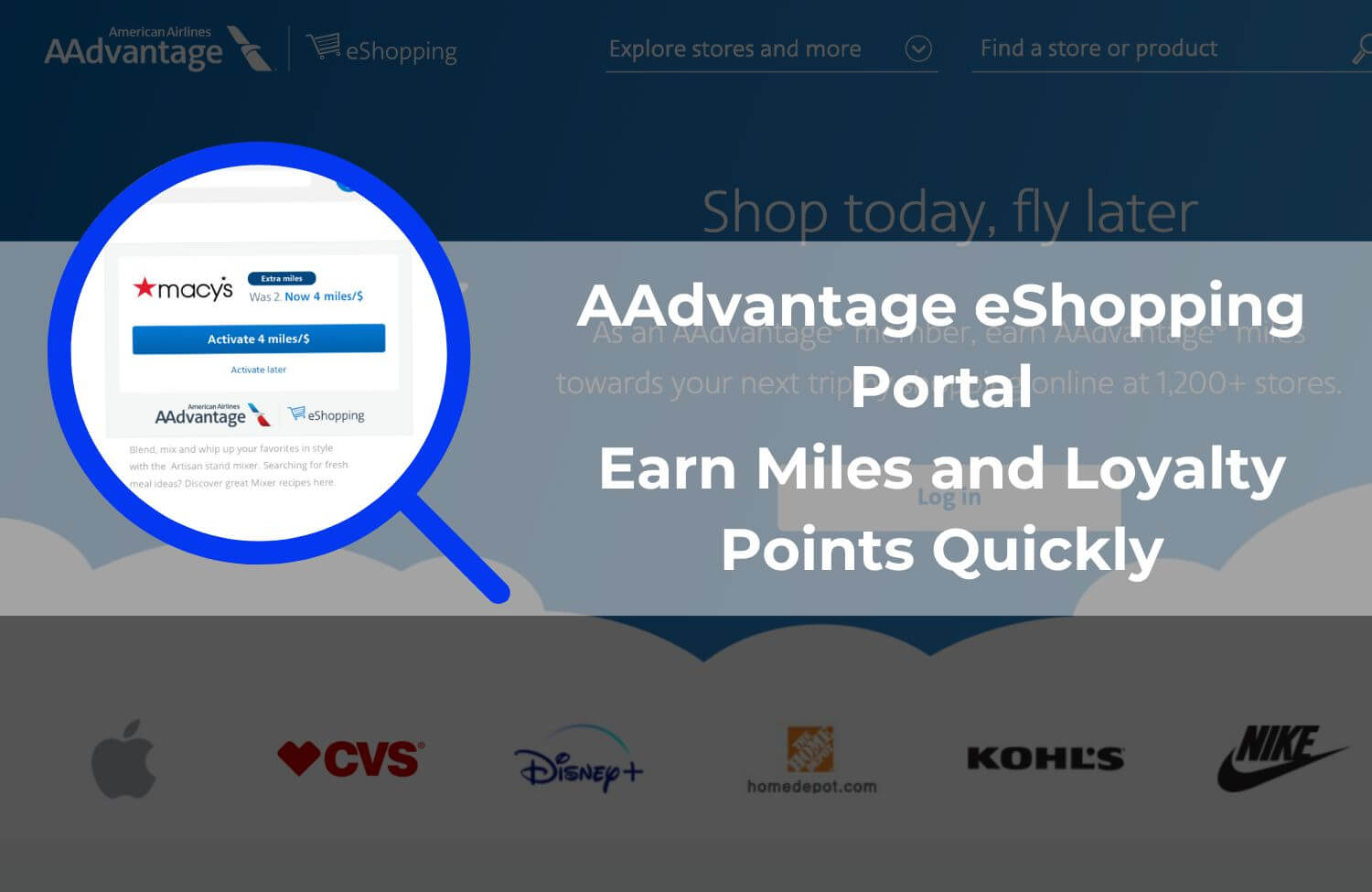
- The AAdvantage eShopping Mall — earning bonus miles on purchases made through AA’s shopping portal at partner retailers.
- Dining and hotel programs — AAdvantage Dining and hotel partners add miles on top of what you’d already spend.
The mechanics of earning are simple; the strategy is in choosing the right transfer partner for the miles you’re not earning directly — which is where AAdvantage gets more restrictive than most other airline programs.
American Airlines Transfer Partners: Which Cards Actually Move Points to AAdvantage
This is where a lot of points collectors get tripped up. If you’re used to Chase Ultimate Rewards or Amex Membership Rewards moving freely between a dozen airline programs, AAdvantage breaks that pattern: neither Chase nor Amex transfers to AAdvantage. In 2026, the direct-transfer list is short. (If most of your balance sits in one of those two currencies, see How to Maximize Amex Points for Flights or Best Capital One Transfer Partners for where those points actually work.)
| Program | Transfer ratio to AAdvantage | Notes |
|---|---|---|
| Citi ThankYou Points — premium cards (Strata Elite, Strata Premier, Prestige) | 1:1 | American’s only major bank transfer partner at full ratio |
| Citi ThankYou Points — no-fee cards | 1:0.7 | Lower ratio than the premium-card tier |
| Bilt Rewards | 1:1 | Transfers directly, no card spend required to earn Bilt points on rent |
| Marriott Bonvoy | 3:1 | Generally a weak conversion — treat hotel-to-airline transfers as a last resort, not a primary strategy |
It’s worth being clear that this list can change — transfer partnerships are one of the more volatile parts of the loyalty landscape, so confirm current ratios and any transfer minimums directly in your card’s rewards portal before moving points. If you’re building a points strategy specifically around AAdvantage, Citi and Bilt are the two currencies to prioritize, since they’re the only ones that convert at a meaningful ratio. Read the full mechanics in our Citi Points Transfer Partners guide and Bilt Rewards Transfer Partners guide — and if a Marriott-to-AA transfer is ever your best option, All the Ways to Transfer Marriott Points walks through when that actually makes sense.
Pro Tips to Maximize Your AAdvantage Miles
- Search a full calendar month, not a single date — dynamic pricing means nearby days can differ by thousands of miles.
- Book partner premium-cabin awards (Qsuites, JAL First) as early as your schedule allows; that inventory disappears fast.
- Stack a Citi ThankYou transfer bonus, when one’s running, with a sweet-spot partner booking rather than transferring at full ratio for an average redemption.
- Price out both directions of a trip separately — American charges per direction, so a cheaper outbound and pricier return isn’t unusual.
- Track your miles’ expiration. AAdvantage miles expire after 24 months of account inactivity — even a small qualifying transaction resets the clock.
- Keep your own log of transfers and redemptions rather than relying solely on the AAdvantage dashboard, especially when points arrive from an outside transfer partner.
- Watch for unannounced Web Special inventory on routes you fly often — it comes and goes without warning, so book it when you see it.
- Compare a partner award against the equivalent American-operated flight before booking; the fixed partner chart can beat dynamic pricing on the same route, or lose to it, depending on the date.
Common Mistakes AAdvantage Members Make
- Assuming a fixed award chart still exists for American-operated flights. It doesn’t — only partner awards follow a published chart.
- Expecting award tickets to be entirely free. Taxes and fees are still due at checkout.
- Assuming Chase or Amex points transfer to AAdvantage. They don’t — only Citi (at 1:1 on premium cards), Bilt (1:1), and Marriott Bonvoy (3:1) do.
- Redeeming for gift cards or hotel stays without comparing the cents-per-mile math first. These redemptions routinely fall under 1 cent per mile.
- Letting miles sit for two years. Inactivity resets the balance to zero at the 24-month mark.
- Booking a partner flight online when the partner requires a phone booking — China Southern, Etihad and GOL among them — and getting stuck at checkout.
Bottom Line
The best use of AAdvantage miles is almost always a flight — ideally a partner business- or first-class redemption in the 57,500–80,000-mile range, or a well-timed off-peak domestic or transatlantic economy fare. The worst use is anything that isn’t a flight: gift cards, hotels, rental cars and onboard extras all land under a cent per mile. Run the value-math formula before you book, prioritize Citi and Bilt if you’re building points specifically for this program, and treat every “free” award ticket as a discount, not a giveaway — the taxes and fees are real.
Frequently Asked Questions
How many AAdvantage miles do I need for a free flight?
It depends entirely on route, cabin and date, since American uses dynamic pricing for its own flights. Domestic economy can start around 7,500 miles one-way; a partner business-class seat to Europe runs 57,500 miles one-way at the fixed partner rate.
Do American Airlines miles expire?
Yes — after 24 months of account inactivity. Any qualifying activity, including a small transfer or purchase, resets the clock.
Can I redeem AAdvantage miles on partner airlines?
Yes. Oneworld carriers (British Airways, Qatar Airways, Japan Airlines, Qantas, Cathay Pacific and others) plus select non-alliance partners like Etihad are bookable with AAdvantage miles, generally at fixed, region-based pricing rather than dynamic pricing.
Which credit cards transfer points to AAdvantage?
Citi ThankYou Points (1:1 on premium cards, 1:0.7 on no-fee cards), Bilt Rewards (1:1), and Marriott Bonvoy (3:1). Chase Ultimate Rewards and Amex Membership Rewards do not transfer to AAdvantage.
Do I still pay taxes and fees on an award ticket?
Yes. Miles cover the base fare in points, but taxes and carrier fees are charged separately at checkout, even on a fully "free" award flight.
Is it worth redeeming AAdvantage miles for hotels or gift cards?
Almost never. These redemptions typically land under 1 cent per mile, well below the 1.3–1.4 cents flights are worth on average — and far below what a well-chosen partner sweet spot can return.
What is a Web Special award on American Airlines?
It's discounted mileage inventory American releases on its own operated flights to fill soft-demand routes — the source of those low, headline-grabbing fares like 7,500 miles one-way domestic. It's promotional, not permanent, and it can disappear without notice.
How much are American Airlines miles worth on average?
Roughly 1.3 to 1.4 cents each for a typical flight redemption, based on 2026 valuations from NerdWallet and The Points Guy. Target a partner premium-cabin sweet spot and that value climbs well past 2 cents — sometimes past 6.