
Chase Aeroplan Card: Up to 60K Welcome Bonus

PointsCrowd is a community-supported platform. When you apply for a credit card, make an order, or otherwise interact with the advertisers through the links on this page we may earn an affiliate commission. This helps us maintain and develop the platform further at no cost to you.
Quick Card Overview
- Annual Fee: $95
- Rewards Rates: 3X Aeroplan points per \$1 on Air Canada purchases, groceries, and dining (including takeout/delivery); 1X on all other purchases. Plus a 500-point bonus for each $2,000 spent in a calendar month (up to 1,500 points/month)
- Welcome Offer: 60,000 Aeroplan points after \$3,000 spend in the first 3 months (posts up to 8 weeks after qualifying)
- Recommended Credit: Good to Excellent (typically FICO ~700+)
- Rules for Welcome Bonus:
- Denied by Chase’s 5/24 rule if you have 5+ new credit cards in the past 24 months
- No welcome bonus if you’ve already received this card’s bonus in the past 24 months
- The Aeroplan 25K status benefit from this card is one-time only; if you earned it via this card in the last 60 months, you can’t get it again
The Chase Aeroplan Card is a co-branded Air Canada credit card issued in the United States. It offers above-average earning rates, a solid welcome bonus of 60K bonus points, and Air Canada-specific benefits (such as free baggage allowance and automatic Aeroplan 25K elite status) for an annual fee of $95. It is designed for US-based travelers who choose Air Canada or Star Alliance partners.
In this review, we’ll break down the math, explain the rules for earning bonuses, detail the ins and outs of earning points, and highlight who will benefit the most.

The Numbers: Is the Annual Fee Worth It?
Let’s do the math. The \$95 fee is moderate, but the key is whether your rewards and perks reliably exceed it.
Valuation approach:
- Point valuation: Assume 1.25¢ per Aeroplan point (the fixed rate when redeeming via Chase’s Pay Yourself Back).
- Perk value: Tally cash-equivalent value of perks you’ll actually use (free bag, Global Entry credit, etc.).
- Subtract fee: Compare total value to the \$95 cost.
Scenarios:
- Big bonus, big win: If you earn the 60,000-point bonus and redeem at 1.25¢, that’s \$750. Minus the \$95 fee, you net \$655 in year one. (Redeeming for premium flights could push the effective value even higher.)
- Steady spender: Without the bonus, but spending \$12,000/year on groceries/dining, you’d earn 36,000 points (3X on those), worth \$450. Add roughly \$100–\$120 of value from the free bag and Global Entry credit, and you’re in positive territory versus \$95.
- No-bonus, low usage: If you don’t earn the welcome offer and spend little in bonus categories, your return will likely be under \$95/year, making the card a net cost.
We assume 1.25¢ per point redemption value (earnings from Pay Yourself Back). We count a used free checked bag as $30–$35 in savings, and the $120 Global Entry credit spread over 4 years (~$30/yr). Only perks you actually use are counted. Unused benefits are not valued, and award booking fees/taxes are ignored (which can offset some value).
Welcome Bonus: Can You Realistically Earn It?
Current Offer: 60,000 Aeroplan points after spending \$3,000 in the first 3 months on the Aeroplan Card. Chase says points post within ~8 weeks of meeting the spend.
Hitting $3,000 in 3 months is usually manageable – that’s $1,000/month. You can accelerate it by shifting regular spend (groceries, dining, utilities) onto the card. Just plan ahead so you meet it within 3 months of account opening.
Value of the Bonus: At 1.25¢ per point, 60,000 points = $750 in travel redemptions. If you use the points smartly (e.g. business-class Air Canada or Star Alliance flights), you might squeeze 1.4–1.5¢/pt (worth $840–$900). If you redeem cheaply (discount economy flights or gift cards), you get the base value. Treat $750 as a baseline.
Best Past Offer: This card previously had higher offers. In mid-2025, a tiered 75K + 25K offer (up to 100K) appeared, and 70K after $3K was in the market. The current 60K is the “regular” level. If you’re not in a hurry, it might pay to wait or watch for special promotions.
Restrictions:
- You’re ineligible for a new bonus if you got the Aeroplan Card bonus in the last 24 months.
- The card follows Chase’s 5/24 rule: having 5+ new card accounts in 24 months will automatically reject you.
- The instant Aeroplan 25K status (discussed below) is only granted once. If you earned it via this card in the last 60 months, you can’t get it again.
Who Is Eligible to Use the Card?
The Aeroplan Card has some strict eligibility checks. Before applying, make sure you can’t trigger any of these red flags:
- 5/24 rule: If you’ve opened 5 or more personal credit cards (any bank) in the last 24 months, your application will be denied.
- Aeroplan bonus history: If you received this card’s bonus in the past 24 months, you cannot earn another bonus.
- Aeroplan 25K lockout: If the card’s automatic 25K status benefit was awarded to your account in the last 60 months, you won’t get it again.
- Credit score: Chase generally expects a “Good” or better credit score (FICO ~700+). Thin files or recent delinquencies will hurt your approval odds.
In practice, if you’re already over 5/24 or fall into one of the above traps, you should skip this card. Otherwise, it’s worth considering if you want its benefits.
Earn Points
You’ll earn 3x at grocery, dining (including delivery), and direct Air Canada purchases, 1x everywhere else, plus 500 bonus points for every $2,000 spent in a calendar month (up to 1,500 points per month). Points don’t expire while your Aeroplan card is open.
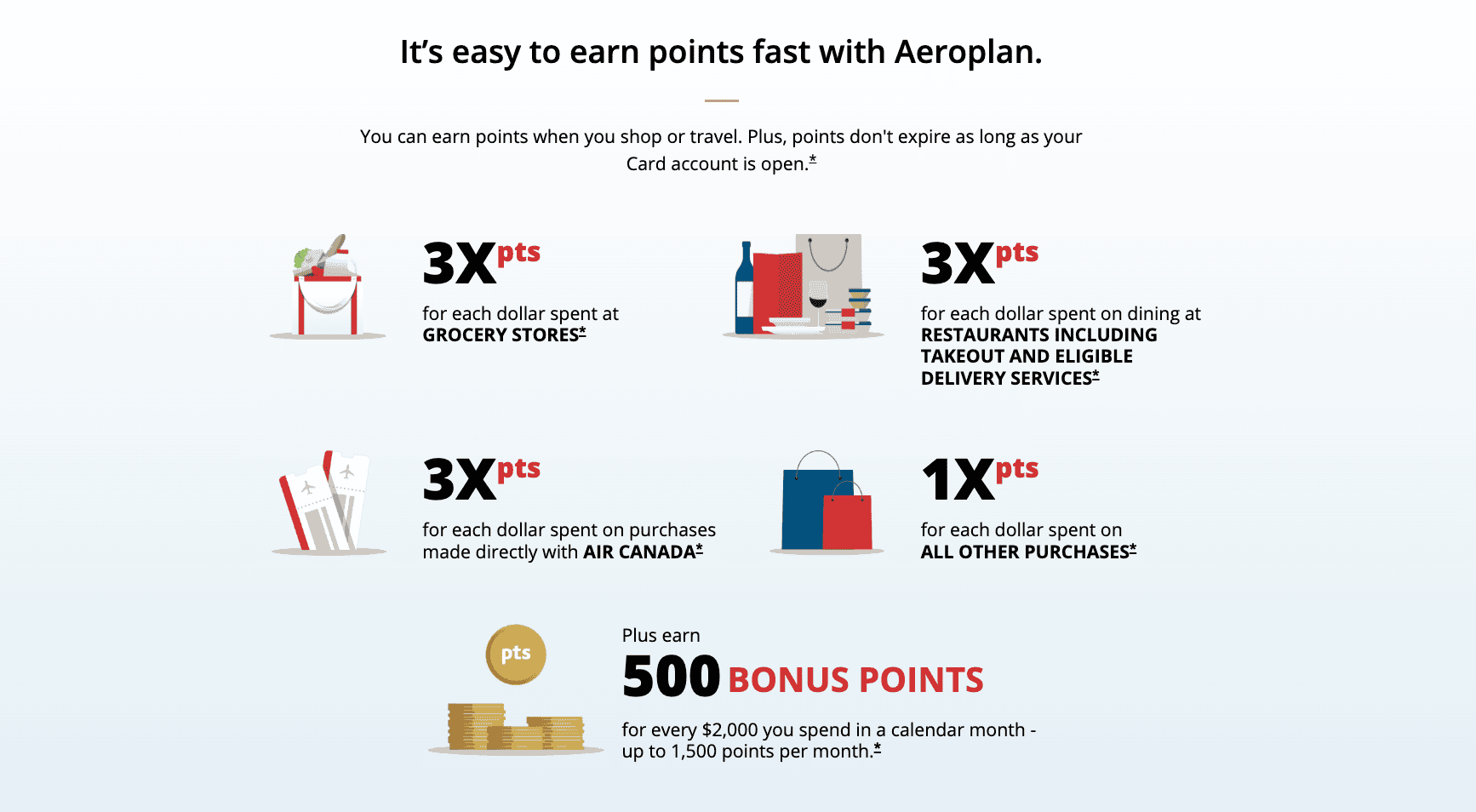
Category Details
- Air Canada purchases must be made directly on aircanada.com or an official Air Canada channel. (Gift cards, hotels, car rentals, vacation packages, and Wi-Fi bought through Air Canada count only as “other.”)
- Groceries generally include most U.S. supermarkets. Note that warehouse club spend (Costco, Sam’s Club) and superstores (Walmart, Target, etc.) often code differently and may not earn 3X.
- Dining covers restaurants, takeout, and many delivery services. Again, some merchants might not code as dining.
Monthly Bonus
The card adds 500 points for every $2,000 you spend in a calendar month (capped at 1,500 bonus points each month). In effect, that’s a +0.25x boost on the first $6,000 every month. It’s a nice little kicker if you have high spend, but it’s not worth chasing on its own.
Common Pitfalls
Many users forget coding quirks. For example, if you buy an Air Canada vacation package instead of a flight, you won’t get 3X (those often code as travel or as an Air Canada transaction itself). Similarly, buying groceries at a Costco likely earns only 1X. A quick test: make a $10 purchase in a category, then check your statement to see if you got 3X. It only takes a few minutes to verify your favorite stores.
Elite Bonuses and Credits
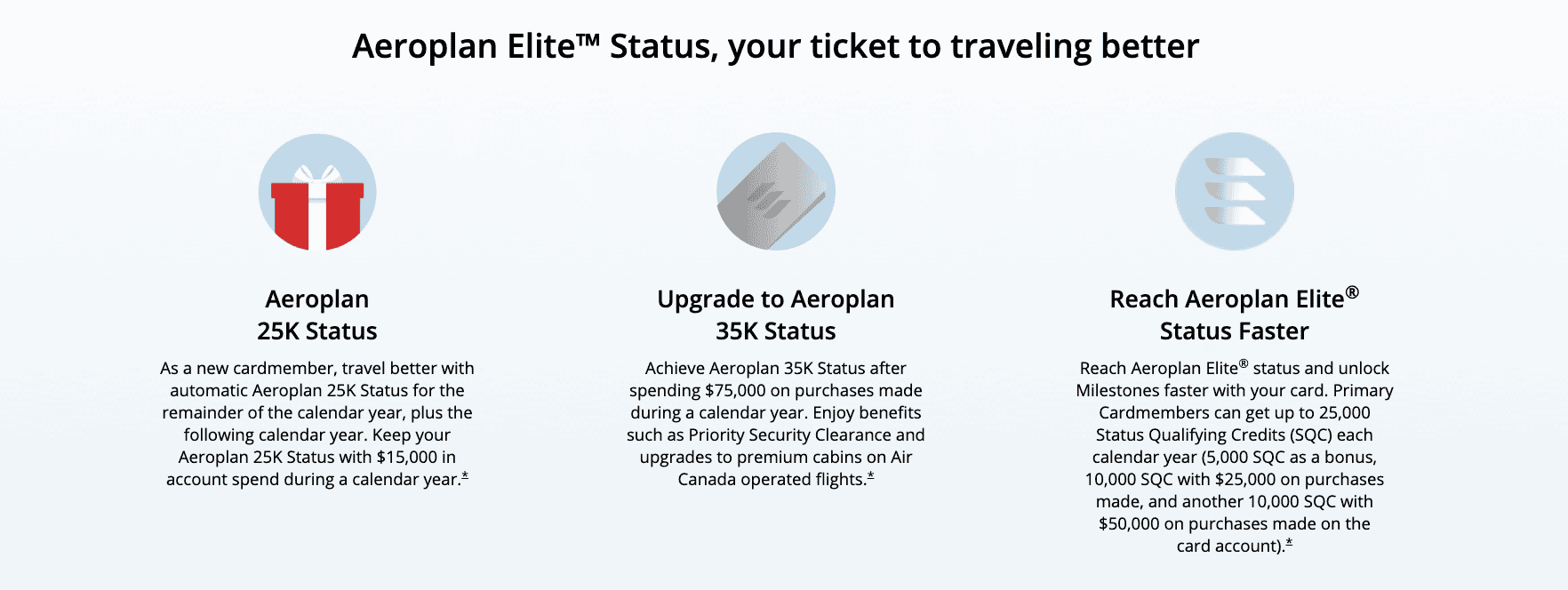
This card isn’t a “status accelerator” in the way some premium cards are, but it does tie into Aeroplan elite status:
35 Aeroplan Elite Status By Spending $75,000/year
Earn 35K toward Aeroplan elite status by spending $75,000 in a calendar year on the card. For almost everyone, this is an unreachable threshold and not a realistic benefit.
Automatic Status Aeroplan 25K
This is the big one. New primary account holders get automatic Aeroplan 25K (entry-level) status for the remainder of that calendar year and the next. You must link your Aeroplan account to the card; it should post automatically, but you may need to double-check that your Aeroplan number is correct in your Chase profile. 25K status includes perks like a free seat selection, a free checked bag (on Air Canada), priority boarding/check-in, and more.
To keep 25K status beyond those initial years, you must spend \$15,000 on the card in each calendar year. If you don’t hit that, you’ll drop back to base Aeroplan membership level.
60-Month Rule
Remember, you only get this auto-25K once per 60 months (check before applying if you’ve had that perk from Chase/Aeroplan in the past).
Annual points that entitle you to status
Each calendar year, the primary cardholder will receive 5,000 SQC (upon receiving the Chase Aeroplan card and thereafter, by the end of February of each subsequent year). Regardless of the number of Chase Aeroplan cards, this bonus is received once a year. If your Chase Aeroplan Card account is closed for any reason, any SQC provided in the current elite year will be removed from your Aeroplan account, and your Aeroplan elite status and benefits provided in connection with this annual SQC benefit may also be cancelled, revoked, or voided.
Also, each calendar year after $25,000 in eligible spending, the cardholder will receive 10,000 SQC and an additional 10,000 SQC after you spend $50,000 on purchases using your account.
Purchases that do not count toward qualifying expenses: balance transfers, cash advances, traveler’s checks, foreign currency, money orders, wire transfers or similar cash-like transactions, lottery tickets, casino chips, racetrack bets or similar transactions, any checks that access your Chase Aeroplan card account, interest, unauthorized or fraudulent charges, and any fees, including the annual fee.
Benefits: What Matters and What Doesn’t
The card comes with several travel-related perks. Here’s what to expect in real value:
High Value
- Free First Checked Bag: Cardmembers (and up to eight companions on the same reservation) get the first checked bag free on Air Canada flights. That can save about $30 each trip (international fares can be even more). If you travel even occasionally with family or a companion, this benefit alone can justify much of the fee. Note: The flight must originate on Air Canada – a codeshare partner flight would not count.
- No Foreign Transaction Fees: Purchases made outside the U.S. incur no foreign currency fees. This is standard on premium travel cards now, but it’s very useful if you travel.
- Global Entry/TSA PreCheck (NEXUS) Credit: Up to $120 back every 4 years for Global Entry, TSA PreCheck or NEXUS application fees. Simply charge the fee to your Aeroplan Card and you’ll see the credit. This is worth $30/year (if you use it once), amortized over 4 years.
Medium Value
- Aeroplan 25K Status: As discussed, automatic 25K status (with easy maintenance path) is valuable if you fly AC or Star Alliance. It saves on bags, gives priority boarding/check-in, etc., and preferred seat selection. If you don’t fly much on Air Canada, you may not value it.
- Preferred Pricing on Air Canada Awards: The card often unlocks lower Aeroplan point prices on Air Canada-operated flights, the Aeroplan site shows discounted award options for cardholders. This is usually 10–30% off standard pricing.
Low Value
- Mastercard Concierge: You have access to a 24/7 concierge line for dining reservations or event tickets. Most people never use this.
- Pay Yourself Back (Travel Statement Credit): You can redeem Aeroplan points for statement credits on recent travel, dining, or groceries at 1.25¢. It provides some flexibility if you don’t want traditional award travel. However, it’s not PLASTIC money – it only covers specific categories within 90 days of purchase. This is more a fallback option, not a core benefit.
Protections Deep-Dive
The Aeroplan Card provides Chase’s standard travel and purchase protections for a mid-tier card.
In general:
- Travel Insurance: Expect basic coverage for trip delays (typically a set dollar amount per day after a qualifying delay, up to a cap), trip cancellation/interruption (up to a dollar limit per trip), and lost/delayed baggage (per person/baggage).
- Purchase Protections: Standard Mastercard World Elite features apply: likely purchase protection (covers theft or damage on new purchases, usually up to a certain dollar amount per claim for a set period) and extended warranty (doubles U.S. manufacturer warranties, typically up to 1 additional year).
This card offers basic protection insurance, but not at the level of premium travel cards. If you need primary auto rental insurance (it’s secondary here), high trip cancellation limits, or higher purchase protection caps, you might need a higher-tier card (e.g. Chase Sapphire Reserve or an Amex Platinum).
Is the Card Worth It?
Most likely value comes in year one via the bonus and easy perks. If you qualify for the bonus and redeem points for 1.25¢ each, you’re about $650+ ahead after the first year. Ongoing value depends on your spending habits: to justify the $95 yearly fee, you’ll want either a reasonable run at the next bonus (e.g. waiting for a higher future offer), or annual spend in the 3X categories (groceries/dining/AC) of at least $3,000, plus using the free bag and global-entry credit.
Decision Flow:
- Apply now if: You’re not 5/24, haven’t had this card’s bonus in 2 years, and plan to actively use Air Canada or are okay redeeming via Pay Yourself Back. The \$95 fee can pay for itself easily in year one.
- Wait/skip if: You’re ineligible (5/24 or bonus lockout), or you prefer a card with more flexible rewards. If you don’t value Aeroplan points (or don’t fly AC), this card may underperform a general travel card for you.
You often fly airlines outside of Star Alliance, want transferable points (like Ultimate Rewards or Membership Rewards), or simply won’t shift substantial spend to this card. In those cases, alternatives like the Chase Sapphire Preferred (flexible UR points) or a solid cash-back card (for 3%+ groceries/dining) might be smarter.
Cash Back Options + Point Transfers
Most people choose the Chase Aeroplan credit card for its welcome bonus and the ability to redeem points for airline tickets, but this card has two “non-airline” superpowers that are easy to overlook:
- You can redeem Aeroplan points for credit (Pay Yourself Back)
- You can use points for more than just air travel
- You can transfer points to Aeroplan from other Chase cards (and even get a bonus for the transfer) or transferring Aeroplan points to another person
1) Pay Yourself Back (statement credits)
If you want flexible value (especially when award ticket prices aren’t very favorable), Chase allows you to redeem Aeroplan points for statement credits through Pay Yourself Back on eligible purchases made with your Aeroplan card — usually within a set period after purchase (Chase describes this as within 90 days).
What this means in practice:
- You can pay for the eligible purchase with cash, then go to Chase and reverse that payment using Aeroplan points for statement credit.
- Eligible categories and redemption values may change over time, and Chase shows the value before you confirm the redemption.
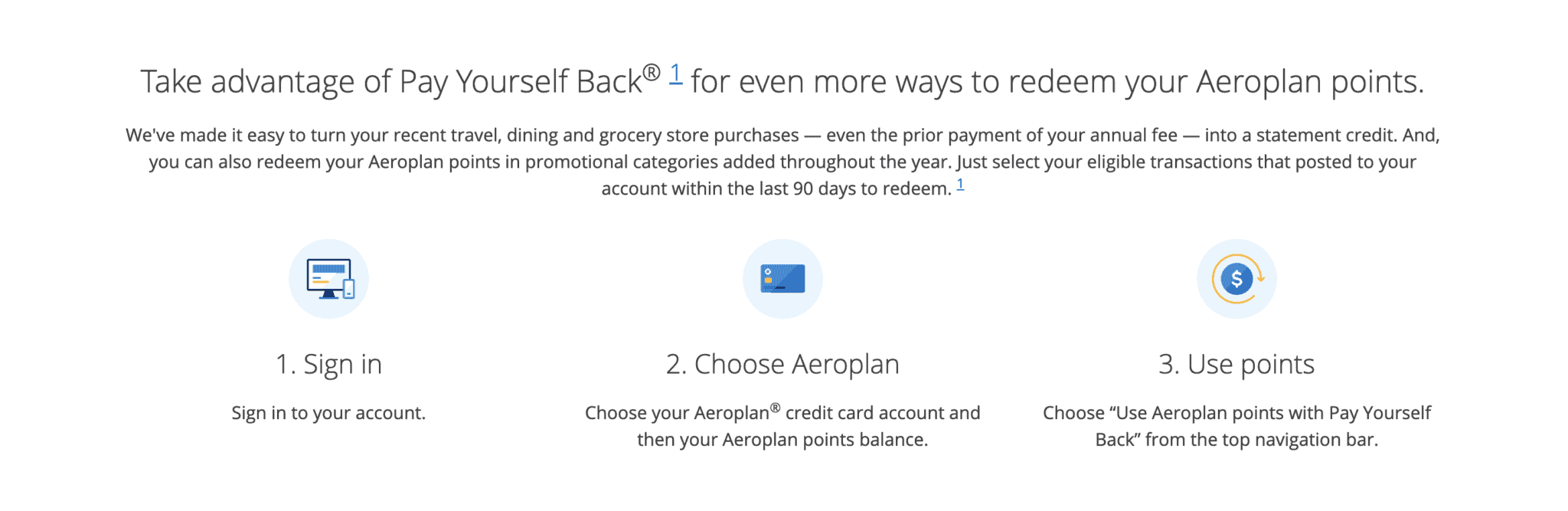
It makes sense to use this feature when the price of award tickets is extremely high and you prefer to simply book a ticket with cash.
2) Use Aeroplan points for more than just air travel (hotels, cars, gift cards)
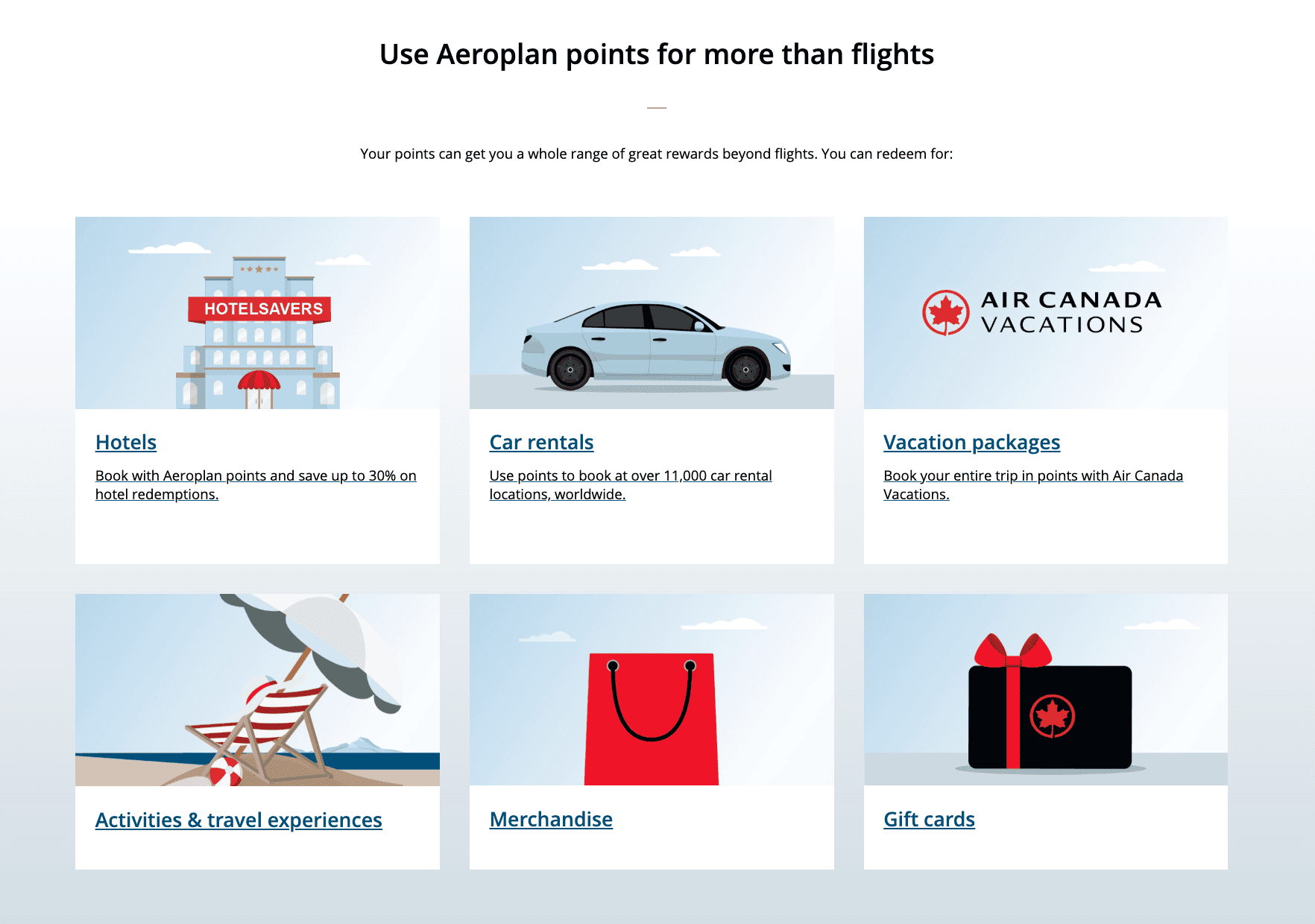
Even if you stay with Aeroplan, you are not limited to air travel. Aeroplan directly supports the use of points for:
So if you have a large sign-up bonus and your next trip is more like “hotel + car rental” than “award flight,” you can still turn your points into real value for your trip.
3) “Transfer points”: two different meanings
Transfer Chase Ultimate Rewards → Aeroplan

If you also have a qualifying Chase Ultimate Rewards card (e.g., Sapphire/Ink, which can be transferred to airline partners), your Aeroplan card can unlock a 10% bonus when you transfer 50,000+ Ultimate Rewards points to Aeroplan in a single transaction (up to the annual bonus limit).
Why this matters:
- This turns your Aeroplan card into a booster for your entire Chase ecosystem — useful when you’re building up your account for a premium cabin redemption or a family trip.
Transferring Aeroplan points to another person (or sharing with family)
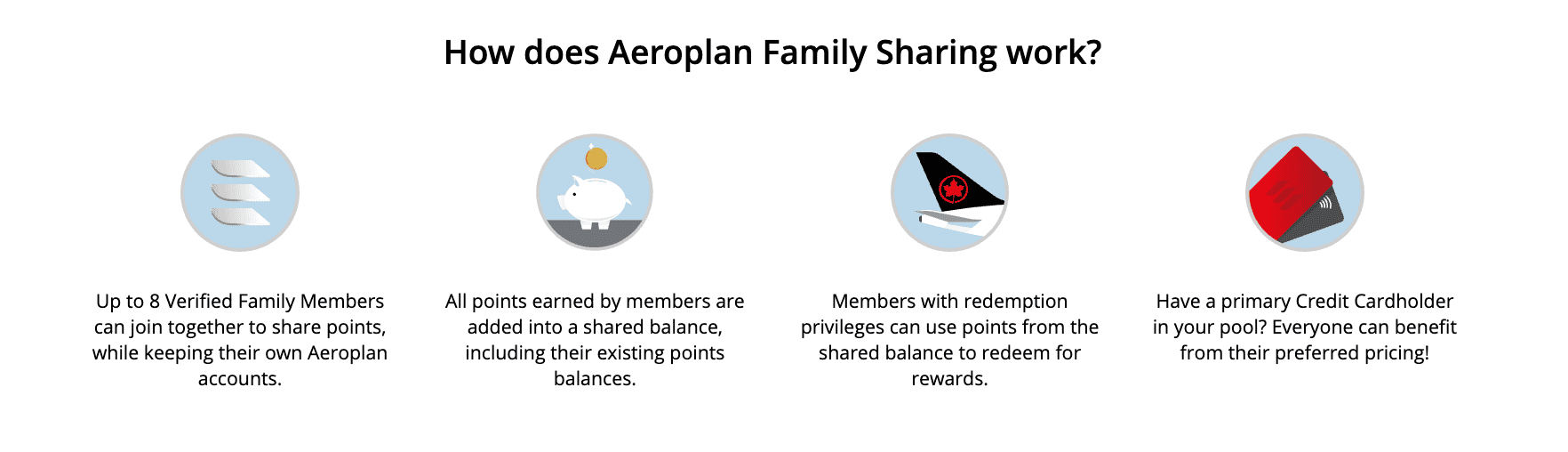
Aeroplan also allows:
- Paid point transfers to another Aeroplan member (for an additional fee).
- Family sharing (pooling points with no transfer fee if you’ve created a family pool under Aeroplan rules).
If your goal is flexibility for your family, family sharing is usually a better solution than paying a transfer fee (when available/applicable in your situation).
Combining with Other Cards
The Aeroplan Card works best as a specialized “niche” card. Since you can’t transfer its points into Chase’s Ultimate Rewards ecosystem, it generally doesn’t pair with other Chase cards for point pooling.
Use this card for its bonus categories (groceries, dining, Air Canada flights) and put everything else on a no-fee cash-back card (or vice versa). If you have other Chase cards, you might consolidate all your flexible travel spend on a Sapphire Preferred/Reserve and treat Aeroplan as a bonus-category card for groceries/dining only. apply, contact Aeroplan support (they can sometimes manually grant the baggage benefit after the fact).
Bottom Line
The Chase Aeroplan Card is tailor-made for US-based travelers who can take advantage of Air Canada-specific perks. If you fly Air Canada/Star Alliance enough to value Aeroplan points, and you spend in groceries and dining, it can be a very rewarding card. The first-year bonus alone easily covers the $95 fee if you’re eligible. Beyond the bonus, you’ll need to shift meaningful spend to the card or use the free checked-bag and status perks to stay ahead.


