
Capital One VentureOne Card Review: No-Fee Travel Rewards Breakdown

PointsCrowd is a community-supported platform. When you apply for a credit card, make an order, or otherwise interact with the advertisers through the links on this page we may earn an affiliate commission. This helps us maintain and develop the platform further at no cost to you.
Quick Card Overview
- Annual Fee: $0
- Intro APR: 0% on purchases and balance transfers for 15 months
- Purchase APR: 18.49%–28.49% variable (for well-qualified applicants)
- Earn Rewards Rates: 5X miles on hotels, vacation rentals, and rental cars booked through Capital One Travel; 1.25X miles on all other purchases
- Welcome Offer: 20,000 miles + $100 travel credit after $500 spend in 3 months (as of March 2026)
- Recommended Credit Rating: Good to Excellent (FICO 670–850)
- Rules for Welcome Bonus: Not eligible if you’ve received a VentureOne bonus in the past 48 months or opened any Capital One card in the past 6 months
The Capital One VentureOne Rewards credit card is one of the most popular travel credit cards, offering simple and flexible rewards with no annual fee. Its features include easy earning, a modest welcome bonus, a 15-month 0% introductory APR on purchases and balance transfers, and access to several airline/hotel partners — all on a zero-fee card. But with competition heating up in the free travel card market, does VentureOne still stand out from the crowd, or is it just another “introductory” card that’s more hype than substance?
In this review, we’ll figure out what VentureOne is really worth to real users and whether it deserves a place in your wallet compared to competitive options such as Wells Fargo Autograph or Citi Double Cash.
The Numbers: Is the Annual Fee Worth It?
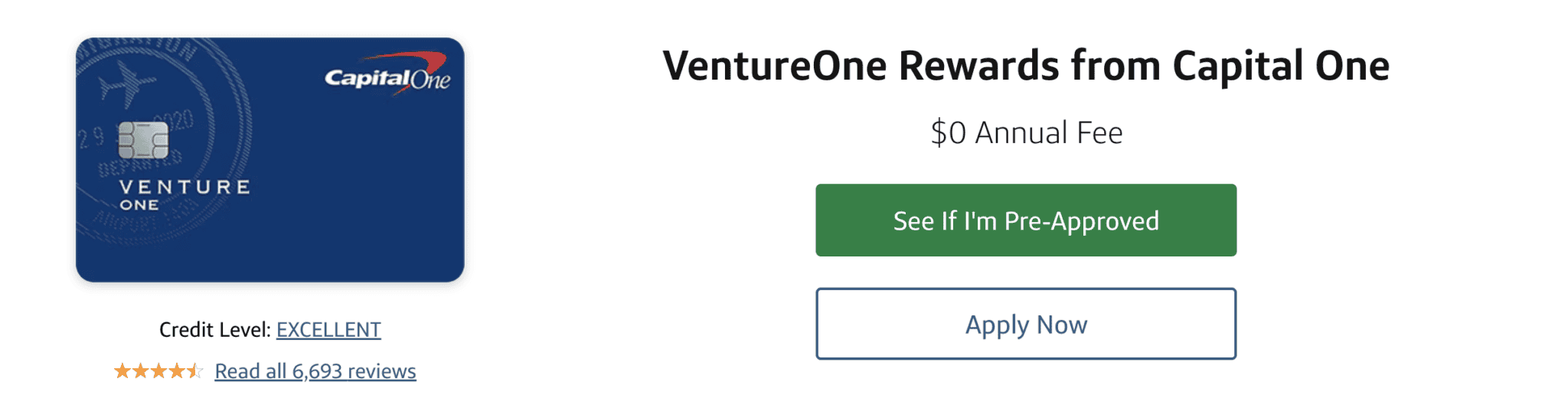
With an annual fee of $0, the VentureOne break-even calculation is extremely simple: any positive value from rewards or benefits is a net plus. However, not all users will receive the same benefit. The welcome bonus alone can be worth approximately $200–$370, depending on how you use your miles. You will consistently earn 1.25 miles per dollar on most purchases, as well as 5 miles on hotels and car rentals booked through the Capital One Travel portal. Users who frequently use the portal will see a greater return than those who spend primarily on airfare or everyday categories outside the portal.
For a traveler who spends $500 in the first 3 months, the math is simple: 20,000 miles (at $0.01 each) equals $200, plus a $100 travel credit, for a total of $300. If you transfer those miles to a high-value partner (e.g., Air France Flying Blue at ~1.5 cents/mile), the value of the bonus can increase to approximately $370. The actual value depends on how much you spend in the 5X category and whether you use the bonuses at 1 cent or look for good partner deals. In our conservative estimate, we assume 1 cent per mile for travel use, up to ~1.85 cents when using optimal airline rewards. We factor in $100 in travel credit only if you book through Capital One Travel, and we value Hertz Five Star status at approximately $100–$200 per year for frequent customers. Unused perks or miles that you lose are not factored in.
Welcome Bonus: Can You Realistically Earn It?
As of March 2026, the public offer is 20,000 miles plus a $100 Capital One Travel statement credit after spending $500 in the first 3 months. The bonus clock starts at account opening (not card activation), so it’s crucial to begin spending promptly to meet the $500 target. The minimum spend ($167/month on average) is easy for most users, and the bonus typically posts within one or two billing cycles after you hit it.
The real catch is eligibility. Capital One is strict: you won’t get the bonus if you’ve received a VentureOne bonus in the past 48 months or opened any other Capital One card in the last 6 months. These “velocity” rules are not obvious on the application, so many savvy applicants check their history first. If you run afoul of the 6/48 rule, you’ll waste a hard inquiry and get no bonus.
Historically, the bonus has varied from the baseline 20,000 miles to a limited-time 40,000 miles + $100 credit in late 2025, but such elevated offers are rare and short-lived. If you do see an unusually high bonus, it’s worth timing your application to snag it. Always confirm the current offer before you apply, as Capital One can change these terms with little notice.
Who Is Eligible to Use the Card?
Capital One’s strict “velocity” rules mean many applicants get tripped up. You can’t earn the VentureOne bonus if you’ve opened another Capital One credit card in the past 6 months or received a VentureOne (or Venture) bonus in the past 48 months. There’s no easy workaround: if you’ve been active with Capital One recently, the safest play is to wait until you’re past those windows. Otherwise, your application will cleanly qualify you but with no bonus at the end.
The recommended credit profile is “Good to Excellent,” roughly a 670+ FICO score. Approval below that range is rare. There are no known pre-approval offers or in-branch special deals for this card. Existing VentureOne cardholders can’t get a second bonus, and product-changing from another Capital One card does not reset your eligibility.
Earning: How You Rack Up Value
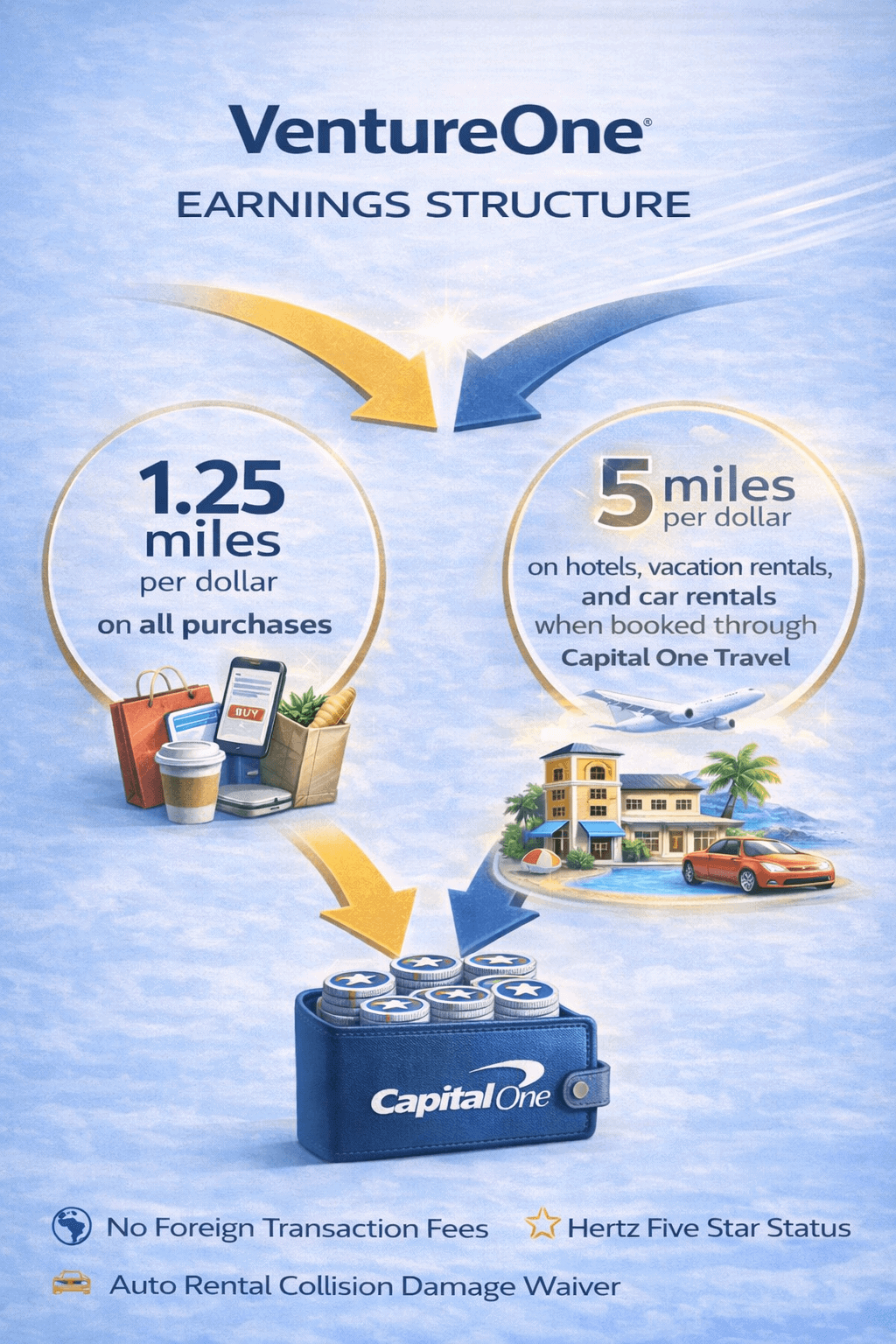
The VentureOne’s earning structure is simple:
- 1.25X miles per dollar on all purchases,
- 5X miles on hotels, vacation rentals, and rental cars when you book through the Capital One Travel portal.
However, details matter. The 5X rate only applies to bookings made via Capital One’s portal – if you book the same hotel or rental directly or through another site, you earn just 1.25X. Crucially, flights are excluded from the 5X bonus, even when booked in the portal. This is a common point of confusion, as Capital One’s marketing can sound vague. In practice, only lodging and cars hit 5X, all other travel (including airfare) is just 1.25X.
There’s no cap on rewards, and miles don’t expire as long as your account is open. But note: if you close the account or convert it to another card, you forfeit any unused miles. In plain terms, keep the account open or transfer the miles before closing.
Maximizing your rewards means changing some habits. Before booking a hotel or rental, always price-check the Capital One Travel portal. For example, if a hotel booking at $150 is available via Capital One Travel, that $150 yields 750 miles (5X). Book the same room directly, and you’d earn only 188 miles (1.25X). If speculation or convenience makes you book outside the portal, you’re effectively missing out on up to 5% back in rewards.
For non-travel spend, 1.25X is “okay” but not market-leading. Other no-fee cards like Citi Double Cash (2% cash back) or Wells Fargo’s Active Cash (2% back) will beat it on everyday purchases. The key is knowing where VentureOne shines: its best use is as a supplemental portal card. If you mostly spend in other categories (groceries, streaming, etc.) and never use the Capital One Travel site, you might get more overall rewards elsewhere.
People often assume all travel is 5X or forget to use the portal. A good habit is to make a small $10 booking as a test when first using the portal, then confirm that it posts at 5X in your statement. Always verify the earning rate after a new booking to ensure you didn’t miss a detail.
Automatic Elite Status: Hertz Five Star

With VentureOne, you become eligible for complementary Hertz Gold Plus Rewards Five Star status. This elite status grants benefits like priority service, enhanced upgrade odds, and more skip-the-counter options at many locations. It can be worth roughly $100–$200 per year if you rent cars frequently.
However, Hertz status is not automatic. After approval, you must enroll in Hertz Gold Plus Rewards and register your VentureOne card number as your payment method — only then will Hertz grant you Five Star. In most cases, the status appears immediately, but some users report having to call Hertz to confirm activation. The key: don’t assume you have Five Star on day one. After you get your card, sign up with Hertz, link the card, and double-check your status before your next rental.
Benefits: What Matters, What Doesn’t
The VentureOne’s benefits package is surprisingly solid for a no-fee card, but not all perks will be relevant to every user. We rank them by value:
High Value:
- No Foreign Transaction Fees – This card charges no fee on purchases abroad. Many no-fee cards still charge ~3% on foreign spend, so this is a big plus for travelers.
- Capital One Travel Portal Access – While not a “benefit” line item, the ability to book travel through Capital One’s portal at 5X earns is effectively a high-value perk if you use it wisely.
Medium Value:
- Hertz Five Star Status – As discussed, regular renters can extract real value here. If you’re an occasional renter, you may not notice much difference.
- Auto Rental Collision Damage Waiver – Pay for a car rental with this card, and you get secondary collision/theft coverage (up to 31 days). This lets you decline expensive rental agency insurance if you have personal coverage already. It’s secondary (your own car insurance would pay first), but better than nothing. Remember, this covers damage/theft only, not liability or personal injury.
Low Value:
- Extended Warranty – This benefit doubles the original manufacturer’s warranty up to 24 months for eligible new items (with an original warranty of 36 months or less). Handy if you buy electronics, but most travel-focused users might not care much.
- Travel and Emergency Assistance Services – A 24/7 hotline for emergencies (medical, legal, etc.) while you’re traveling. Kind of like having a travel expert on call. Useful as peace of mind, but rarely used.
- Concierge Service – 24/7 concierge for bookings or reservations. Again, a nice perk but not something most people regularly use.
Most benefits apply automatically. The main exceptions are Hertz status (you must enroll manually) and rental coverage (you must pay with the card and file a claim if needed). If you value overseas travel and priority car rentals, VentureOne is quite competitive among no-fee cards. If not, remember these perks and don’t count on them for big savings unless you actually use them.
Protections Deep-Dive
The VentureOne offers two main cardholder protection packages:
- Auto Rental Collision Damage Waiver – Covers damage or theft on rental cars paid for with your card, up to 31 days per rental. (Coverage is secondary to your personal insurance, and excludes things like exotic vehicles or intentional damage.) This is standard for travel cards, whether no-fee or premium.
- Extended Warranty Protection – Doubles eligible warranties (up to 24 months) for electronics purchased with the card. (Original warranty must be two to three years. It doesn’t apply to used items.)
What’s not included: There is no trip cancellation/interruption, trip delay, or baggage insurance on this card. If you need those protections (common with premium travel cards), you’ll have to look elsewhere or rely on a paid travel insurance policy. In short, VentureOne’s protections are solid for car rentals and electronics warranties, but skip the travel insurance extras.
Is the Card Worth It?
In the first year, a successful VentureOne strategy can net you roughly $200–$370 in bonus value (depending on redemption) plus whatever you earn from spending and Hertz status. With no annual fee, everything is upside — just make sure you meet the bonus spending in time and have no conflicting recent Cap One accounts.
Use the VentureOne if:
1) You have a 670+ credit score and meet the 6/48 eligibility rules,
2) You plan to use Capital One Travel for hotels or car rentals at least occasionally,
3) You just want a simple no-annual-fee card that earns transferable miles. It’s especially handy as a “portal play” for lodging and cars, or as a way to pool miles with a premium Capital One card (like Venture or Venture X) without extra fees.
Decision Flow (Simplified):
- Eligible: Good FICO, no recent CapOne cards or bonuses ⇒ Apply.
- Not Eligible: Applied/opened another CapOne card in <6 mo or got a Venture/VentureOne bonus <48 mo ⇒ Wait (don’t apply yet).
- Finally: If you’ll never use the portal or value high base rewards more, you may want a different card.
This card is likely a poor fit if you mostly want high rewards on groceries, dining, or non-travel spend, or if you rarely book hotels/rentals via Capital One Travel. In those cases, cards like a flat 2% back (e.g. Citi Double Cash) or a broad 3X rewards card (e.g. Wells Fargo Autograph on travel/dining/gas) may deliver more bang for your buck in your spending categories.
Combining with Other Cards in the Ecosystem

In Capital One there are two kinds of rewards:
- Cash back (dollars) — like Savor / Quicksilver
- Miles — like VentureOne / Venture / Venture X
Savor (cash back) + VentureOne (miles)
Who this is for: people who spend a lot on groceries + restaurants + entertainment + streaming.
- Savor earns 3% cash back in those “food & fun” categories and 5% on Capital One Travel
- VentureOne earns miles and can give you access to transfer partners (airlines/hotels)
You use Savor for the categories where it earns more, and you keep VentureOne as the travel “engine” (miles) for transfers/eraser.
Concrete scenario:
- You spend $800/month on groceries + dining + entertainment.
- With Savor at 3% you earn $24/month (≈ $288/year) If Capital One lets you move/merge rewards in your account, you can often route those rewards into miles by combining rewards with a miles card (this is why many people keep a Venture-family card). Then you can use miles for travel or transfer to partners.
Venture X (or Venture) + VentureOne
This is for people who already have a Venture-family premium card but want a $0-fee backup.
- Venture earns 2X miles everywhere
- VentureOne earns 1.25X (so it’s weaker for daily spend), but it’s $0 annual fee
Why keep VentureOne then?
- It’s a no-fee place to keep your miles strategy alive if you ever downgrade or stop using a paid card.
- You can also separate “earning” and “storage”: earn on Venture/Venture X, keep/organize miles across accounts if needed (Capital One generally allows combining rewards between your Capital One accounts).
Risks, Gotchas & “What I Wish I Knew”
Intro APR Season: This card has a 15-month 0% intro APR, but be aware that if that period ends and you carry a balance, your purchase APR will be 18.49%–28.49%. Plan to pay off any transfers or purchases by the deadline, or don’t use this card for balance transfers unless you can clear them quickly.
Portal Confusion: Not using the portal correctly. Only hotels, rentals, and vacation rentals booked via Capital One Travel earn 5X. Other travel (flights, Airbnb, etc.) is only 1.25X. Always check your statement after a travel purchase to ensure the correct bonus posted. If in doubt, do a small test charge through the portal and verify the rewards afterward.
Travel Credit Use: The $100 travel credit typically applies only to bookings made on Capital One Travel and is non-refundable if unused. In other words, you generally have one chance to use it per calendar year on a Capital One Travel purchase. Make sure you understand the conditions (and confirm by calling Capital One if unclear) before relying on that credit.
Miles on Account Closure: Any miles in your VentureOne account vanish on closure or product change. If you ever plan to close or convert this card, make sure to redeem or transfer all miles beforehand (or leave a small balance to keep it open long enough to move them).
Lack of Travel Insurance: If you’re used to premium travel cards, note that VentureOne gives zero trip interruption or baggage insurance. Every travel incident (missed connection, delayed luggage, etc.) will have to be solved out of pocket or through other means. That’s standard for a no-fee card, but it’s one more reason to proceed with caution on travel plans.
Recovery Playbook (Missing Bonus): If your bonus doesn’t post, first verify you hit the $500 spend in 3 months and met all rules. If everything checks out, contact Capital One with documentation. If the issue is velocity rules, there’s no overturning that, so best to wait out the eligibility window before reapplying.
Transfer of Points
VentureOne miles can be transferred to several airline and hotel partners, generally at a 1:1 ratio. For a full list and transfer ratios, see an expert guide. Transfer partners let advanced travelers unlock outsized value — up to ~1.5¢–1.85¢ per mile by booking premium cabin award flights.
Transfers are irreversible and often take up to 36 hours, so only move miles when you have confirmed award availability and are ready to book.
For most users, the simplest redemption is spending miles like cash on travel at 1¢ per mile through Capital One (e.g. a $200 cash ticket costs 20,000 miles). Cash or gift card redemptions are typically only worth ~0.5¢/mile, which is generally a poor value and should be avoided if possible.
Bottom Line
The Capital One VentureOne Rewards Card is best for beginners and value-focused travelers who want simple, transferable travel rewards with no annual fee. Its first-year “payout” is typically $200–$370 (bonus + credits), and ongoing value comes if you reliably use the Capital One Travel portal (for 5X rewards) or leverage partner transfers. The biggest trap is misunderstanding the earning and eligibility rules — so do your homework on the 6/48-month rule and the portal details.
If you fit the profile (good credit, willing to use the portal, and want an easy no-fee card), this is a strong choice. If you’re really chasing high ongoing rewards without using the portal, then consider alternatives like a high-return cash-back card (Citi Double Cash) or a broader 3X card (Wells Fargo Autograph). But for the right user, the VentureOne delivers a lot without demanding an annual fee, making any rewards you earn pure gain.


